US: Trump limits citizenship by birth - and also targets surrogacy
Two new decrees could deny foreigners US citizenship for their children. The Constitution remains untouched. However, authorities should be able to refuse documents.
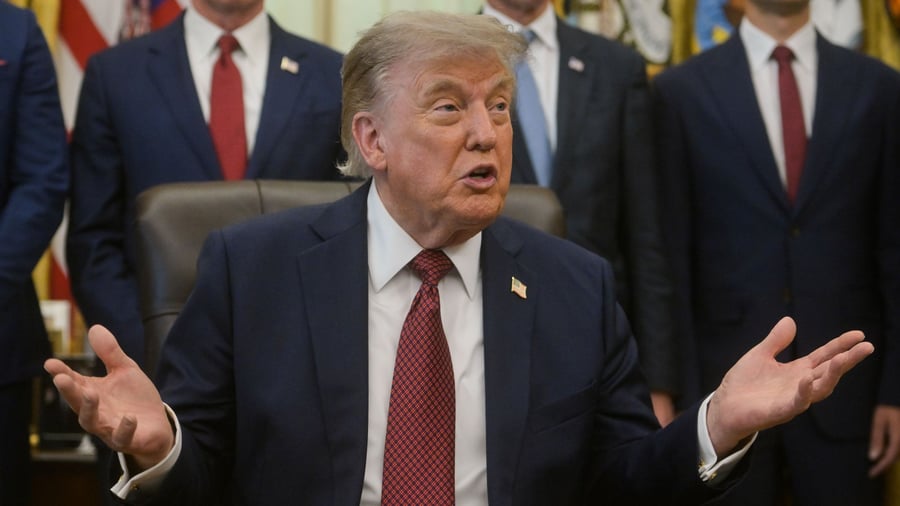
Two new decrees by US President Donald Trump could have far-reaching consequences for the surrogacy industry in the United States. In the night of Friday, Trump signed two presidential decrees to restrict the right to citizenship by birth in the US. Furthermore, "birth tourism" is to be curbed, as stated in the decrees. According to the White House, this will expand the circle of people who are not entitled to US citizenship.
A previous move by Trump was rejected by the Supreme Court in June. Under the right enshrined in the Constitution, every child born in the US is granted US citizenship - regardless of the nationality of its parents.
What the decrees can do - and what they cannot
Trump's decrees do not change the Constitution, but they give government and law enforcement agencies broader powers to identify possible abuse and, for example, refuse to issue visas, birth certificates or passport documents. The US government also reserves the right to subsequently revoke US citizenship from people if it was obtained "under false pretenses".
The decrees are also relevant to the multi-billion-dollar US surrogacy industry. The crucial sentence is in section two of the decree "Continuing to protect the meaning and value of American Citizenship". According to this, US authorities may refuse to recognize a child as a US citizen if no parent is a US citizen and the parents have entered into a commercial agreement with a surrogate mother in the US.
The section not only refers to "birth tourism" when a pregnant woman travels to the US as a tourist solely for the purpose of giving birth there. The decree also explicitly mentions surrogacy as a separate case.
The White House instructed the US State Department, the Department of Homeland Security, the Department of Justice, and the Social Security Administration to adjust their procedures accordingly. The authorities have 30 days to do so.
The Spahn case highlights the legal situation
In the case of surrogacy, the US citizenship of the child is an important part of the business model for international customers and corresponding agencies. Therefore, the decree could cause significant uncertainty in the industry about what is legally possible and what is not.
A prominent example of a foreign citizen who used the services of a surrogate mother in the US is the Union politician Jens Spahn. He and his husband founded a family with the help of a US surrogate mother. The baby born in the US has US citizenship.
Subsequently, Spahn faced accusations of double morality because he publicly supported the ban on surrogacy in Germany, which his party advocates. Spahn resigned as head of the Union parliamentary group on July 18.
However, German citizens are likely to make up only a very small proportion of foreign couples who hire a surrogate mother in the US. In the US, there is greater concern about Chinese and Russian citizens who buy US citizenship for their children through surrogacy.
Republican deputies and immigration opponents have long argued that surrogacy can be used by foreigners to obtain US citizenship for children. In Congress, there is a discussion about the so-called Safe Kids Act, which would restrict surrogacy agreements with nationals of certain countries.
The trigger was reports about super-rich Chinese who had numerous children born by surrogate mothers in the US. A particularly extreme example was taken up by the Wall Street Journal: A surrogate mother in Florida gave birth to triplets for a single man in China, who initially did not seem to take care of the children after birth. A dispute over the transfer has erupted. The man rejects the allegations.
Soon significantly stricter checks?
Surrogacy is prohibited in Germany but allowed in other countries. A woman carries a child for the desired parents. The embryo is created by artificial fertilization, and the surrogate mother is usually not genetically related to the child. The procedure is used by people who cannot have children for various reasons.
In principle, the use of tourist and business visas with the primary goal of obtaining US citizenship for a newborn is already prohibited. However, prosecution is very complicated, and the evidence of a corresponding intention is also.
The Trump decrees now indicate that the US government will examine foreigners who have children in the US much more strictly than before. The White House also expands the circle of people who are not entitled to citizenship by birth. So far, this has affected foreign ambassadors in the US, among others. Now, all employees of an embassy and a consulate, as well as "people who work for a foreign government", will no longer be entitled to an American passport for their baby born in the US.
Translated by urgent.news. Machine-written — may contain errors; check the original before relying on it.