The electromagnetic spectrum: It’s more than visible light
The light our eyes can detect is only a sliver of the light out there. The electromagnetic spectrum describes all the wavelengths of light, seen and unseen. The post The electromagnetic spectrum: It’s more than visible light first appeared on EarthSky .
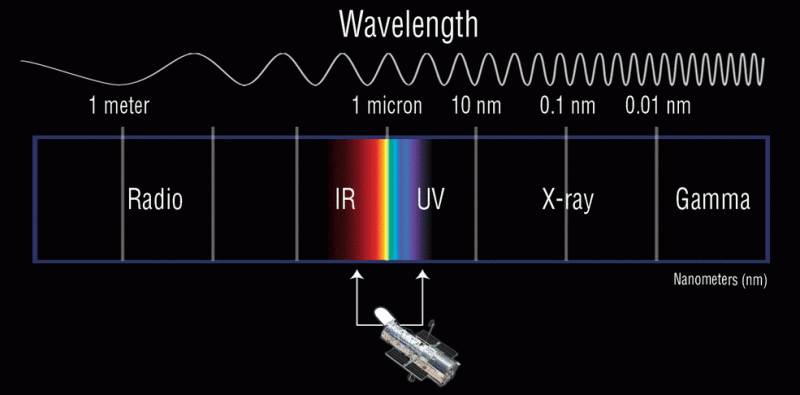
The electromagnetic spectrum stretches far beyond the range of light visible to the human eye. This spectrum includes radio waves, microwaves, infrared, visible light, ultraviolet, X-rays, and gamma rays, each with distinct wavelengths and energies. While our eyes perceive only visible light, which ranges from red to violet, scientists utilize the entire electromagnetic spectrum to study the universe.
Radio waves and microwaves, the longest wavelengths and lowest energies, allow astronomers to explore cold and dense regions of space. Radio telescopes have been instrumental in mapping the structure of our galaxy and tracking the movement of cold gas. Additionally, microwaves can detect the remnant glow of the Big Bang.
Infrared light, with its longer wavelengths than visible light, enables telescopes to penetrate dust clouds and reveal cool, dim stars. It also measures the temperatures of planets in distant solar systems. Infrared telescopes have provided breathtaking views of our Milky Way galaxy's core, showcasing massive star clusters and swirling gas clouds.
The portion of the spectrum that our eyes can detect comprises the visible light, which oscillates between 400 and 790 terahertz (THz). This band includes colors ranging from red, with the longest wavelength, to violet, the shortest. When sunlight passes through a prism, it disperses into a spectrum of colors due to each wavelength being refracted at a slightly different angle.
Ultraviolet light, with shorter wavelengths than visible light, is responsible for the sunburn we experience. Astronomers utilize UV light to identify energetic stars and star-forming regions. Observations in the ultraviolet spectrum, such as those made by the GALEX space observatory, show bright regions where stellar nurseries reside within spiral galaxies.
However, high-energy X-rays and gamma rays, at the top end of the electromagnetic spectrum, are largely blocked by Earth's atmosphere. Astronomers must rely on space-based telescopes to study these regions. X-rays typically emanate from exotic neutron stars or the superheated matter swirling around them. Gamma rays, the most energetic form of light, are produced by extreme cosmic events.
Written by urgent.news from EarthSky's reporting — not their text. Machine-written — may contain errors; check the original before relying on it.