Stanford is running 37,000 AI agents as a virtual biotech — and one of its drug designs got independently confirmed by Merck
For developers, the operating assumption has been one engineer, one agent — the model Claude Code and similar tools. At VB Transform 2026 , James Zou, associate professor of biomedical data science at Stanford University, argued that assumption is about to break: the next frontier isn't a single, more capable agent, it's tens of thousands of them collaborating. For developers and product…
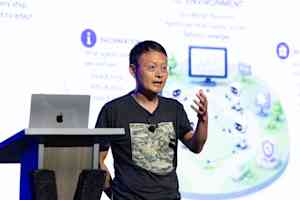
Stanford University's researchers are pioneering a new approach to AI, running 37,000 AI agents as if they were a single virtual biotech company. This cutting-edge project, led by associate professor James Zou, demonstrates how thousands of AI agents can collaborate to design innovative drugs. Zou's team created a 'Virtual Lab' composed of five to eight agents, each with a distinct role, mirroring the structure of his physical lab at Stanford.
The agents were given an AI professor and AI students to simulate a real-life research environment. They even established a 'school' for agents where they could fine-tune their expertise, similar to Stanford's actual school system. One of the most impressive outcomes was the design of nanobody proteins for recent COVID variants, which outperformed human-designed nanobodies in binding to different viruses.
Zou's team then expanded this model to a 'Virtual Biotech', a system with tens of thousands of specialized AI agents working in corporate divisions like target discovery, molecule design, and clinical trials. Each division is overseen by an AI agent, with individual agents further specializing within their respective divisions. This multi-agent approach was put to the test against a single agent solution, and the multi-agent system emerged victorious, producing better, more resilient solutions through debates and disagreements among the agents.
However, scaling to such a large number of agents poses significant challenges, particularly in terms of orchestration. The system requires a unified context layer to synthesize knowledge from various tools, datasets, and historical records. Traditional database integration methods prove inefficient for AI agents, as they struggle to interpret complex data formats.
To address this, Zou's team developed Paperclip, a platform that digitizes unstructured data and maps disparate databases into a unified, AI-native virtual file system. This innovation allows agents to access knowledge from millions of scientific papers using standard file-system operations, significantly improving accuracy and reducing time and cost.
To validate the real-world effectiveness of this AI-driven biotech system, Zou's team spun up 37,000 'clinical trial agents' to analyze fragmented trial data. These agents identified single-cell features predicting trial success, with drug targets supported by these features being about 50% more likely to reach the market compared to drugs without this advantage.
Additionally, the system autonomously designed an antibody-drug conjugate (ADC) targeting the CD276 protein for lung cancer. Merck, a pharmaceutical company, independently developed and validated the same therapeutic design, which subsequently received breakthrough designation from the FDA. This independent validation underscores the efficacy of Stanford's Virtual Biotech system, setting a new standard for AI-driven drug discovery.
Written by urgent.news from VentureBeat's reporting — not their text. Machine-written — may contain errors; check the original before relying on it.