Armament: Hunting bomber drone not until 2035? Rheinmetall warns of delayed procurement
Rheinmetall had wanted to supply the German army with the first deep strike drones at an early date. Now the eagerly anticipated order could fall through. Experts warn that the German army is facing a capability gap.
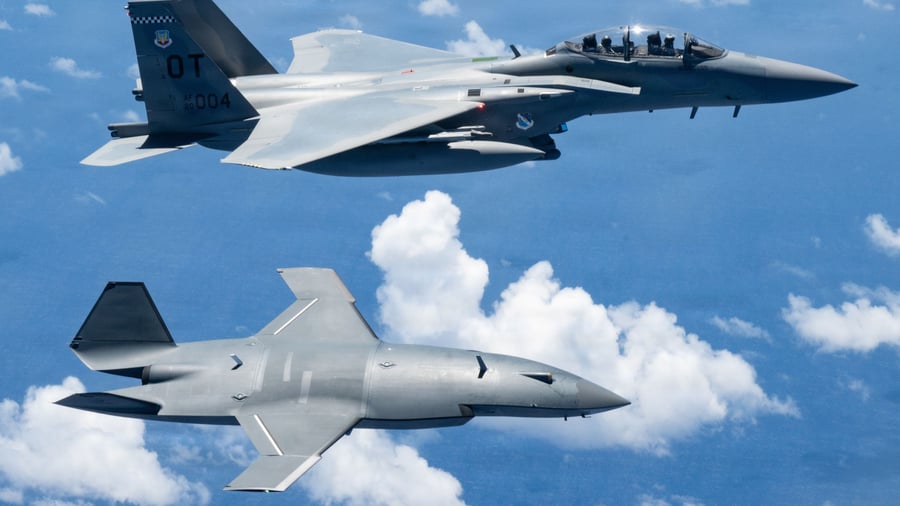
Actually, it was supposed to be a very safe business for Rheinmetall. The German military, known as the Bundeswehr, had planned to procure so-called deep-strike drones. These drones were intended to enable Germany to carry out long-range attacks at a distance of up to 1,800 kilometers. The Bundeswehr had planned to procure a small contingent of around twelve of these "hunter-killer drones," as the air force calls them, and put them into service before the end of the decade.
Rheinmetall had positioned itself for exactly this initial order - and now threatens to come away empty-handed.
This is because there are said to be disagreements between the procurement office and the Ministry of Defense. This was reported recently, among others, by Politico. The initial procurement of market-available drones could now be canceled without replacement, it is said. Instead, an open competition is to be held, in which offers from Rheinmetall, Airbus, and Helsing will be compared.
The US arms company General Atomics has newly joined the circle of possible providers, according to Handelsblatt information. After the decision, a larger number of drones are to be procured directly. Rheinmetall and Boeing, as well as General Atomics, are highly advanced in their development.
The problem: Both Airbus and Helsing are working on their own deep-strike drones, but they are currently not flight-tested. The German start-up Helsing, which cooperates with Hensoldt, among others, currently only has a test model.
Rheinmetall, on the other hand, has teamed up with Boeing Australia. The Australian subsidiary of the US arms company has been working on the MQ-28 Ghost Bat deep-strike drone as part of an Australian government drone program for around eight years. Australia has invested three billion euros in the development.
The drone was used for the first time in June during the US military's "Vailant Shield" exercise over the Philippine Sea, in which several nations participate every two years. Airbus has teamed up with the US company Kratos, whose XQ-58A Valkyrie drone made its first flight in 2019.
However, it is launched via a rocket catapult and lands by parachute, so it would probably have to be adapted to meet the Bundeswehr's requirements. In parallel, the group is working on its own drone called "Ravenstorm," which is expected to be operational in the 2030s.
Like the Ghost Bat, the FQ-42A from General Atomics, which made its first flight in 2025, is also well advanced. In June, the company received the order for series production from the US Air Force.
After the relaxation of secrecy regulations by the US authorities, General Atomics can now also communicate more openly with the Bundeswehr and hopes to win the contract. The drone is suitable for both air-to-air and air-to-ground missions and has stealth properties.
The final assembly and payload integration could take place at General Atomics Aero Tec Systems (ATS) in Bavaria. Tomahawks could bridge the capability gap.
The competitors of Helsing and Airbus are said to have feared that if the Boeing drone were procured initially, competition would be absent because the Bundeswehr might then commit to it for a long time due to long-term use, it is said from the industry.
Should the initial procurement actually be canceled, Rheinmetall expects the Bundeswehr to have to forego corresponding systems for a longer period. A capability gap threatens, warn experts.
"Germany can save a lot of development time and money if it joins the Australian program as a partner nation. Otherwise, comparable platforms are unlikely to arrive at the air force before 2035," says Tim Paul, operational head of Rheinmetall's aviation business.
Glen Ferguson, who heads the MQ-28 program at Boeing Australia, calls for a quick decision. "If the goal is to achieve such a capability by 2029, this work must start today with the development of tactics, training, definition of the military structure, and the integration of sovereign technologies," he says.
According to industry observers, Germany can only bridge the capability gap with Tomahawk cruise missiles. After US President Donald Trump canceled the planned deployment of these missiles in Germany, Germany wants to acquire the cruise missiles.
The Boeing drone can be adapted to the Bundeswehr's needs. Helsing and Airbus expectantly advocate that the procurement office might forego an initial procurement of the Boeing-Rheinmetall drones.
From the competitor's perspective, the drone does not meet the Bundeswehr's needs anyway, as it is a so-called air-to-air drone, as Stephanie Lingemann, head of Helsing's aviation division, recently told the Handelsblatt.
Instead, the Bundeswehr needs an air-to-ground drone, which requires adjustments to the sensors, among other things. Rheinmetall manager Paul counters: "The first drones from Boeing and Rheinmetall would initially not have air-to-ground capability.
But the air force can already gain initial experience with such aircraft, especially with regard to use in conjunction with manned combat jets," he says. According to Ferguson from Boeing Australia, the Ghost Bat was designed from the start as an adaptable platform.
He says: "This is not about retrofitting, but about using a modular design that is fundamentally designed for continuous adaptations." Paul of Rheinmetall also considers the concern that Germany might not have full control over the Boeing hunter-killer drone to be unfounded.
"The Australian authorities have a very high level of influence on the system, and we have a very good partnership with Boeing Australia," he says.
Translated by urgent.news. Machine-written — may contain errors; check the original before relying on it.