Phantasialand: The Germany that rides roller coasters together
When all federal states have school holidays, people come together in one place like this. What do you learn in one day in one of the most visited leisure parks about Germany?
We're here early. Not at Timmendorfer Strand, not in front of the Brandenburg Gate. Even there, we would have been represented, presumably as rarely as anywhere else, during the only week in summer when all of Germany has school holidays. We, the inhabitants of the 16 German federal states. But on this Monday morning, August 3rd, we have chosen Phantasialand in Brühl near Cologne.
Germany's most visited leisure park after Europa-Park, with more than two million guests per year. A place where we come together particularly densely, because the park traditionally suffers from a lack of space and is not exactly known for its spacious green areas. We can hardly get out of each other's way. The website queue-times.com, which claims to get its data from the leisure parks themselves, will reach a so-called crowd level of 91 percent at the end of the day.
So it's pretty full. We want to tell you about this day, about the quintessential Germany, knowing that we won't do justice to everyone. We come, as the license plates show, from CW, MSP, MR, DH, GT, AZ, WO, WAK, SE, and PAF, from the districts of Calw, Main-Spessart, Marburg-Biedenkopf, Diepholz, Gütersloh, Alzey, Worms, Wartburgkreis, Segeberg, and Pfaffenhofen an der Ilm.
From Baden-Württemberg, Hesse, Lower Saxony, North Rhine-Westphalia, Rhineland-Palatinate, Thuringia, Schleswig-Holstein, and Bavaria. We wear sneakers or sports shoes that look like sneakers, in which we never do sports. The women occasionally wear a variation of the sandal. We wear tennis socks or foot socks, white rather than black.
We wear backpacks, backpacks, and more backpacks. If we wear a hat, it's a baseball cap. Everyone can see: we're in leisure mode. We're having fun now.
World champions of waiting in line
We line up before it's even possible to move forward. That means we also stand in line at 9 am in front of the attraction, before the waiting area structured by barriers opens an hour later. Even without this structure, we manage to form a spick-and-span queue that stretches for hundreds of meters through the park. In the supermarket, we call for a second checkout as soon as there are four people in front of us; here, we resign ourselves to the inevitable.
No one pushes in. Except for a fee. For this, you can buy so-called Quick Passes, which allow you to go straight to the attraction through a different entrance. They cost between five and twelve euros, depending on the ride. Those who want to buy them have to queue up in a long line. Some of us do that. Some of us think, honestly, that's not okay.
It also reminds us, even in the utopia of the leisure park, of what rules the world. Every queue is an anachronism. The instant gratification of the internet is momentarily dissolved. Here, we wait as we did 50 years ago. And since there is no instant reward of a roller coaster ride, we turn to the instant reward of Tiktok to pass the time.
But not all of us look at our smartphones; fewer than at the train platform. Many of us are able to talk to other family members. About Elvis' time in Friedberg, Spotify subscription models, or working in Denmark. Outsiders can probably easily tell who likes each other and who is only still a family unit out of habit. Among us are fathers who wait silently with their teenage daughters, probably because they rarely spend so much time together. But we're also the ones who share kilos of sweets from Tupperware containers with each other.
Then we set off. No, then we're taken off. Comfortably on a boat or on a monorail train or on a 40-year-old ghost train. With more than 100 kilometers per hour on roller coasters that are called Taron, Raik, Colorado Adventure, or Black Mamba here. Finally, no thinking about the boss or the account balance
Many of us have lost trust in politics and others, but those who are responsible for our safety and even our lives, we still trust them. Riding a roller coaster is the TÜV-tested exceptional state, the controlled fear of death. When we rush down the hill into the depths, when we're pushed outward in the curves, or when we think we're about to take off, we only think about this moment.
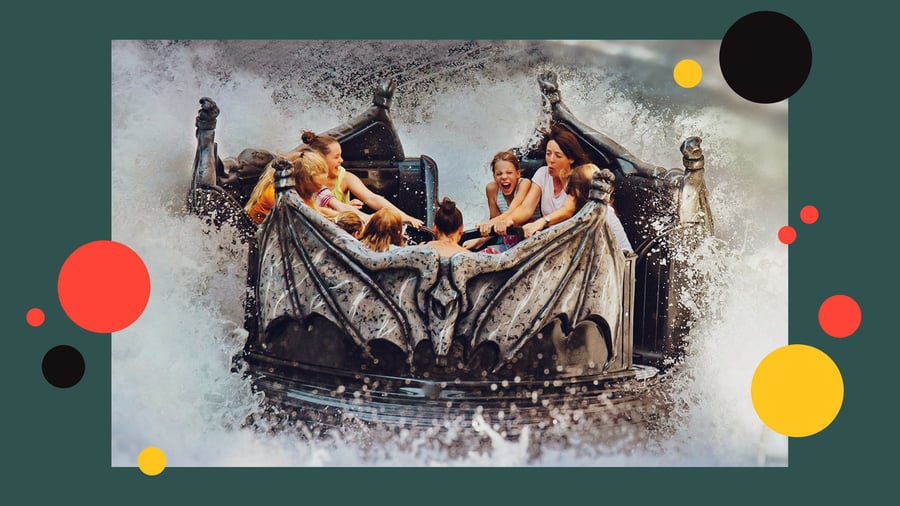
No boss, no account balance. Many of us scream. It can be a shriek like in the 2000s at a Tokio Hotel concert in the front row; sometimes it's more of a "Woaaaaa". We love to ride, on this day with more than 30 degrees in the shade, the ones where we can get seriously wet: the log flume. The waiting times show it: 60 minutes, 70 minutes, 80 minutes.
You can get soaked there or almost not at all. They're the only attractions where a certain unpredictability is part of the concept. The log flume makes no distinctions. It can hit anyone, regardless of age, sex, or income. We enjoy getting wet. We enjoy it when the others in our boat get even wetter. We look over at them, sympathetically, admiringly, or whatever.
One shoe will definitely not dry properly for the rest of the day. At the exit, there's a full-body dryer. A blast of hot air for two euros. We use it even on a midsummer day.
The seconds after we leave the attraction are interesting. We all look at the photo walls of the roller coasters. In the pictures, we all look ridiculous. It's a moment of abandon. But unfortunately, we're good at quickly being somewhere else in our minds. Some of us already look very intent when they run down the stairs; others have pulled out their smartphones. We still need to learn to prolong the moment of the exceptional experience. From one anomaly to the next.
Translated by urgent.news. Machine-written — may contain errors; check the original before relying on it.
Also reported by 1 other outlet
- Phantasialand: The Germany that rides roller coasters together handelsblatt.com