Interview: Deutz CEO Schulte: "We will reach our four billion target earlier"
The engine manufacturer is growing through acquisitions in energy supply and armaments into a broadly positioned group. CEO Sebastian Schulte explained the change in strategy to Handelsblatt.
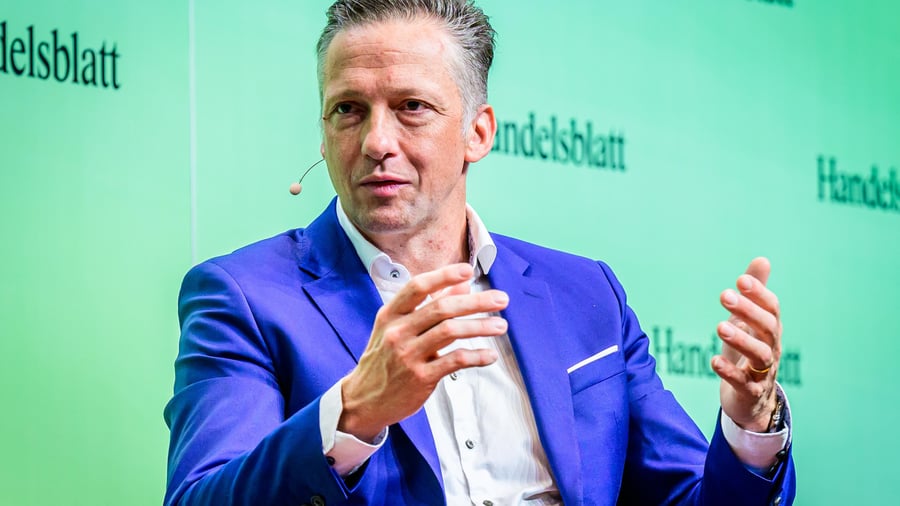
Deutz CEO Sebastian Schulte is stepping on the gas: Instead of 2030, the Cologne-based industrial conglomerate could achieve sales of €4 billion and an operating margin of 10% within the next one to two years. "We will achieve this goal earlier than planned," Schulte says in an interview with the Handelsblatt. The company has recently invested heavily in the defense business, with the acquisition of military vehicle manufacturer Flensburger Fahrzeugbau Gesellschaft (FFG) being the largest acquisition in Deutz's history.
In addition, there are also investments and partnerships in drone drives and unmanned ground systems. Schulte says the strategy has already paid off. The current development also supports the CEO. In the first half-year, sales increased by 11% to €1.12 billion, and new orders rose by almost 30% to more than €1.3 billion. At the same time, Deutz achieved a margin of more than 7% in two consecutive quarters, despite weak demand in the classic engine business.
Herr Schulte, not only Deutz is currently pushing into the defense business, but also numerous other industrial companies. Does the market threaten to become overcapacitated after the boom?
Attractive markets naturally also attract new providers. Who will prevail?
The companies that can scale quickly - while maintaining high quality. This is what has always characterized us. Anyone who comes from the industrial supplier business learns very early on to produce and work efficiently. We bring this experience with us. After all, a doubling of defense spending must also lead to greater performance.
Many companies, especially from mechanical engineering, are orienting themselves towards the defense industry. What lessons do you draw from your entry into the defense industry? What would you do differently in retrospect - or advise other companies?
For us, the conversion was not that great. We have always been component suppliers for mobility and have been supplying the defense industry on a small scale for decades, for example, providing engines for the Patriot air defense systems. Our industrial scaling competence includes both components, drives, and the production of entire systems. Recently, the series production of the unmanned ground system Gereon by Arx Robotics has started with us in Ulm.
The defense boom has driven up the valuations of many defense companies. Is buying now more difficult?
The valuations of listed defense companies have sometimes run ahead - in some cases, multiples of over 25 or 30 were paid. This has corrected somewhat recently, but we still distinguish very precisely between stock market valuations and the M&A market. We do not pay 25 multiples. When we buy a company, the fundamentals must be right, and the risk must be manageable. What does that mean in concrete terms?
In the case of FFG, we are based on a multiple of eight to ten on the basis of the years 2025 to 2027. That is fair. But it's not just about the price. It's also about whether the strategy and corporate culture match. That's why we have already withdrawn from sales processes in the past.
Do you benefit from the special assets - especially in the defense sector?
We want to go into markets that are attractive and not just rely on state incentives. These can be given today and withdrawn tomorrow. Nevertheless, you are moving consistently in the defense direction.
Defense is an important pillar for us. It is true that NATO countries have significantly increased their defense spending for years to come. Regardless of how the war in Ukraine ends, the demand will remain high - either through further support for Ukraine or through the build-up of one's own military capabilities in Europe.
So, you didn't benefit from the special assets at all?
In the market and among our partners and customers, this certainly plays a role. Of course, FFG benefits from structurally higher defense spending in both Germany and other European countries.
You are buying significantly in the defense sector; you had also clearly announced the change in strategy. When would you say your defense strategy has paid off?
It has already paid off. We have not limited ourselves to offering existing civilian products for military use. Instead, we have thought about where the market is heading - for example, with unmanned systems on land and in the air. That's why we acquired Sobek and invested in electric high-performance drives for military drones. At the same time, we have entered into successful strategic partnerships, for example, with Arx Robotics and Tytan Technologies.
What made your strategy work, exactly?
For me, it's crucial to not just announce the strategy but to implement it consistently. This also means that we invest and, where necessary, take entrepreneurial risks.
Is the acquisition of FFG the next proof of this?
Exactly. FFG fits strategically perfectly with us. FFG develops, modernizes, and maintains military vehicles - from recovery and infantry fighting vehicles to personnel carriers and special vehicles. This expands our portfolio, and we become a central player in the defense sector.
How will your shopping tour continue after FFG?
First of all, we need to integrate FFG. This is the largest acquisition in our company's history and naturally binds capacities. We have structured the purchase consciously through a combination of cash payment and shares. However, that doesn't mean we'll stop looking around.
Translated by urgent.news. Machine-written — may contain errors; check the original before relying on it.