Clifford Castle in Clifford, England
If you ever find yourself in western Herefordshire right by the Welsh border, you might chance upon an eerie, ruined castle on a massive mound known as a motte. The history of the castle is extensive, going back to a time when England was under Norman control. In 1070, William FitzOsbern, the 1st Earl of Hereford, constructed an early motte-and-bailey castle known today as Clifford Castle atop a…
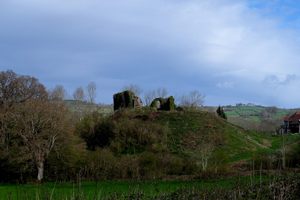
In the western region of Herefordshire, close to the Welsh border, a remarkable ruin known as Clifford Castle can be found atop a large earthwork mound, or motte. This historic site dates back to the time of Norman rule in England, with its construction initiated by William FitzOsbern, the first Earl of Hereford, in 1070. Perched on a cliff overlooking the River Wye, the castle served as a strategic stronghold to protect an envisioned Norman settlement along the river's banks, stretching about half a mile towards the nearby town of Llanfair.
While the original church, St. Mary's, remains today albeit significantly altered during the Victorian era, the castle's location near the River Wye provided an added layer of defense. The waterways were utilized during seasonal floods, forming a natural barrier by transforming parts of the site into a shallow lake or marsh. Following FitzOsbern's death in battle at Flanders, the castle passed to his son, Roger de Breteuil, the second Earl of Hereford.
However, Roger's rebellion against the king in 1075 led to the forfeiture of his lands, and the castle was eventually granted to Ralph Tosny by the Crown.
The Tosny family, primarily engaged in Normandy, added a layer of stone to the castle, mirroring their Conches Castle in Normandy. Gilbert, Sheriff of Hereford, leased the castle for a modest sum of 60 shillings during Ralph Tosny's rule. The castle changed hands again after Ralph's daughter Margaret married Walter Fitz Richard, who later adopted the name Walter de Clifford. This marked the start of the Clifford lineage's connection with the castle.
A notable figure associated with Clifford Castle is Rosamund Clifford, famed for her beauty as the Fair Rosamund and the mistress of King Henry II until her death in 1176 or 1177. This added a touch of romance to the castle's history. Walter de Clifford's grandson, also named Walter, rebelled against King Henry III's rule in 1233, leading to a brief siege of the castle before a reconciliation with the Crown. Walter's defiance was repeated years later, resulting in the loss of some of his privileges as a Marcher Lord.
Upon Walter's death without a male heir, the castle was passed to his daughter, Matilda Clifford, in the 1260s. During the Second Barons' War, John Giffard of Brimpsfield took possession of the castle, subsequently marrying Matilda. Despite the legal implications surrounding their marriage, Matilda chose to reside with Giffard until his death in 1299. Following his demise, the castle was granted to the Mortimers of Wigmore by the king.
Although Clifford Castle boasts a rich history, it currently stands in ruins. Despite its abandonment and ruin for 600 years, it remains a captivating sight for visitors, often overlooked but offering a glimpse into its storied past.
Written by urgent.news from Atlas Obscura's reporting — not their text. Machine-written — may contain errors; check the original before relying on it.