Cars Communicating Badly Is an Already-Solved Problem
The history of networking is full of tools that repurposed solutions to very different kinds of problems first. Wi-Fi’s origins trace back in part to a team of Australian radio astronomers trying to detect signals from evaporating black holes. But the data processing tools they’d developed also proved capable at extracting clean messages from any chaotic, echoing signal environment . Echoes are…
The history of networking is filled with instances where solutions initially designed for different problems have been repurposed for unrelated applications. Wi-Fi, for example, originated from Australian radio astronomers studying signals from black holes, yet its data processing capabilities were soon recognized for their utility in clearing chaotic signals, whether they originated from distant celestial bodies or a distant corner of a house.
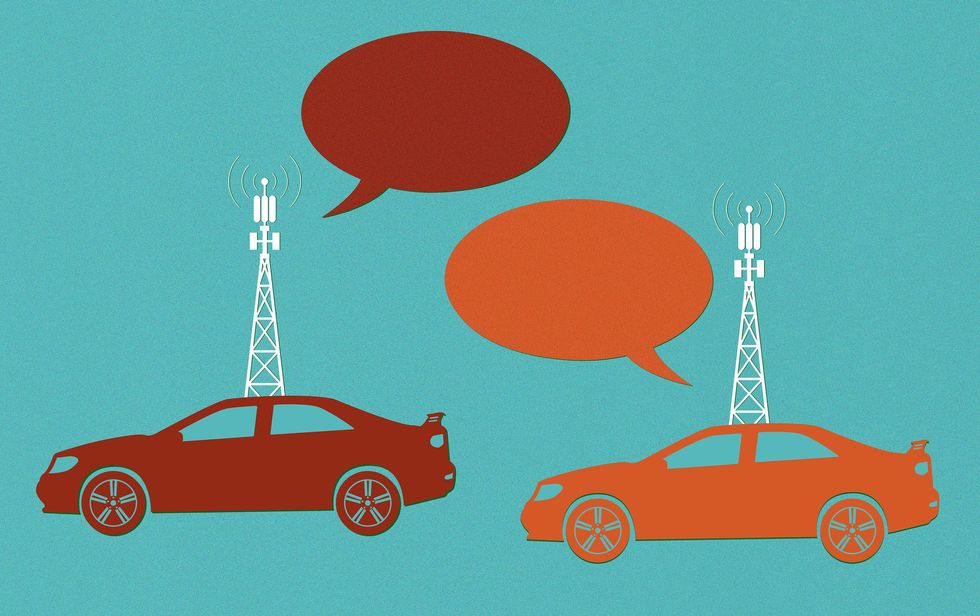
The author's focus lies in vehicle communications networks, specifically those connecting cars to other vehicles and to transportation infrastructure like traffic lights, paving the way for future vehicle-to-everything (V2X) networks. Current V2X research has relied on models assuming "perfect" or "ideal" network conditions, a simplification that fails to account for the unpredictable nature of real-world wireless signals in dense, moving environments.
This gap in reality is precisely where open radio access networks (O-RAN)—an open, programmable architecture behind some 4G and 5G cellular networks—shine.
Despite the potential of O-RAN, its adoption in vehicle communications has not yet taken off. Existing solutions for V2X problems have often relied on developing new networking protocols from scratch, only to encounter issues such as chicken-and-egg scenarios, standards wars, and real signal congestion challenges at scale. O-RAN, by contrast, allows V2X engineers to leverage the networking protocols already developed for cellular communications, making it an appealing option.
While self-driving vehicle technology has often been approached as an isolated endeavor—Tesla, for instance, relying heavily on on-board computers and sensor suites—O-RAN offers an alternative. By connecting cars to their nearby neighbors, wherever they may be on the road, each vehicle can pool the diverse sensors and perspectives of its surroundings for improved group coordination and decision-making. It's important to note, however, that no O-RAN V2X test network exists yet—this approach is still in its conceptual phase.
Although various standards for short-range wireless V2X communication protocols have been proposed in the U.S. and the E.U., no consensus standard has been established. As a result, autonomous car manufacturers like Waymo, Tesla, Zoox, and Cruise have leaned towards a self-reliant approach, equipping vehicles with numerous sensors and GPUs. This is where O-RAN might come into play.
Much like APIs connect apps on your smartphone, O-RAN serves as an API for the network itself, making the network programmable, vendor-neutral, and open to custom applications called xApps. To test the potential of O-RAN in V2X networks, the author and a team simulated five minutes of O-RAN V2X network traffic over a one-square-kilometer urban area, using real buildings, road layouts, and traffic patterns from OpenStreetMap and SUMO, respectively.
These inputs, which include real-world geometry, traffic density, and vehicles' live GPS positions, form a digital twin of the urban environment—a detailed virtual replica that allows the network to reason about the physical world in real time.
The simulations revealed that existing V2X standards result in signal "collision" 80-100 percent of the time, as cars unintentionally transmit messages into the network. However, by employing O-RAN signal coordination, the message collision rate drops to near zero. This is significant because a congested V2X network isn't merely inefficient—it can pose safety risks.
Written by urgent.news from IEEE Spectrum's reporting — not their text. Machine-written — may contain errors; check the original before relying on it.