Benchmarking Cheap LLMs for Production Agent Traces
One LLM call runs on every agent trace we ingest. We found a model 30× cheaper that holds quality, verified against real search traffic.
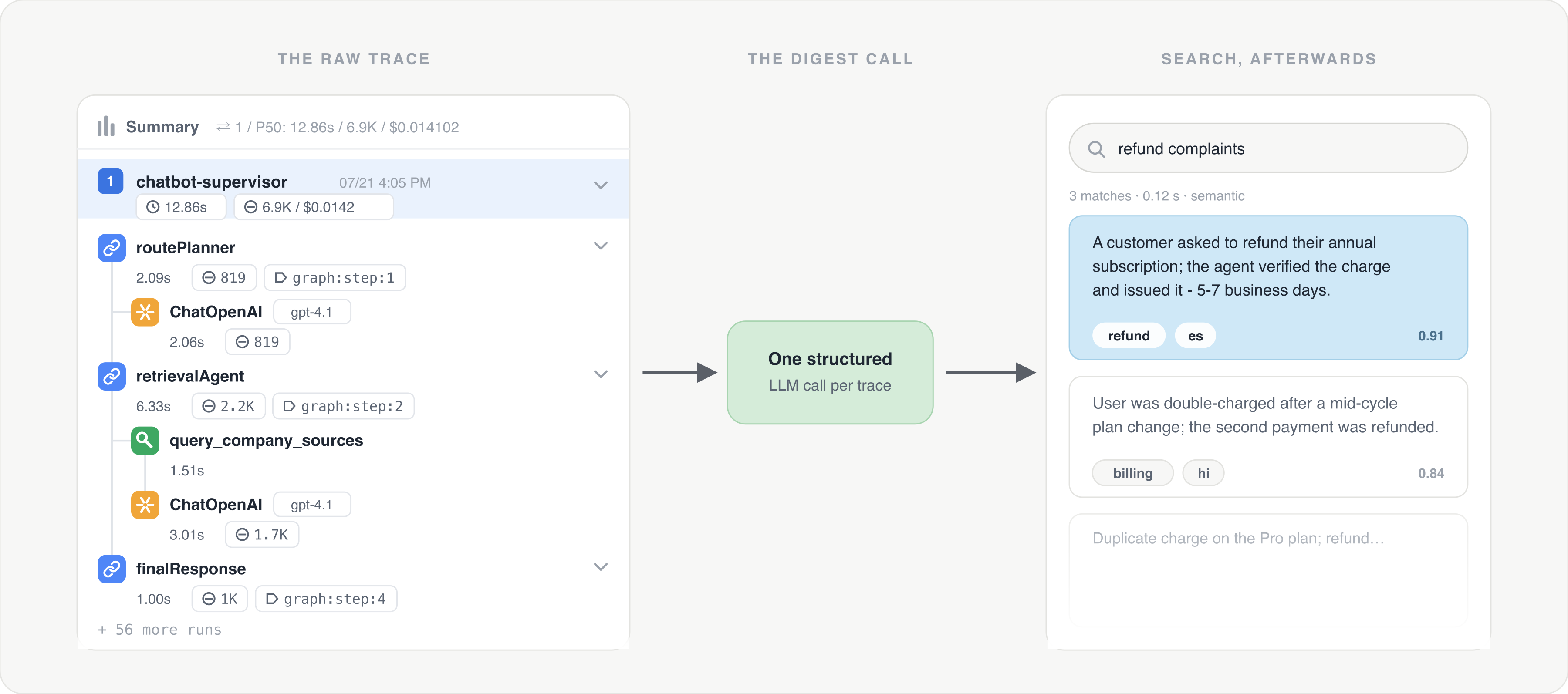
In a cost analysis of inexpensive large language models (LLMs) for trace processing in production AI agents, Sonnet 4.6 was tested against four cheaper alternatives. The study aimed to determine if a more affordable model could produce accurate and cost-effective digests for agent traces, which are used for search, clustering, and monitoring.
Four models were evaluated: Sonnet 4.6, Claude Haiku 4.5, gpt-4o-mini, and Kimi K2.5. The cheaper models were chosen based on their lower prices per 1,000 traces, with gpt-4o-mini being the most economical at $0.11. Claude Sonnet 4.6, currently used in the system, had a benchmark cost of $3.45 per 1,000 traces.
The models were tested on a frozen set of 50 traces, which included real and synthesized traces in various languages, code, SQL, multi-tool runs, crashed runs, and oversized traces. The primary objective was to ensure that the cheaper models produced search results that matched Sonnet 4.6's results. To evaluate the models, they were graded based on their ability to maintain the same search overlap as Sonnet 4.6 while keeping the cost significantly lower.
Additionally, the models were assessed for their quality rules, which measured their performance against the seven trace-grounded rules Sonnet 4.6 promised to uphold, allowing for a 4-point noise band.
Written by urgent.news from HackerNoon's reporting — not their text. Machine-written — may contain errors; check the original before relying on it.