Angeschaut und ausprobiert: Galaxy Z Fold 8: Kompakt, ausdauernd und fast ohne Falte
Das Samsung Galaxy Z Fold 8 überrascht im Alltag: kompakt, ausdauernd und mit fast unsichtbarer Displayfalte – und trotz kleinerem Akku hält es länger durch als das große Ultra-Modell.
Once dismissed as a rare curiosity, foldable smartphones have long been plagued by a persistent problem: most users rarely use them beyond eighty to ninety percent of the time. Samsung's previous models in the Fold series were often unwieldy, with the outer display making it difficult to type. With the Galaxy Z Fold 8, the company has made a bold departure from this trend.
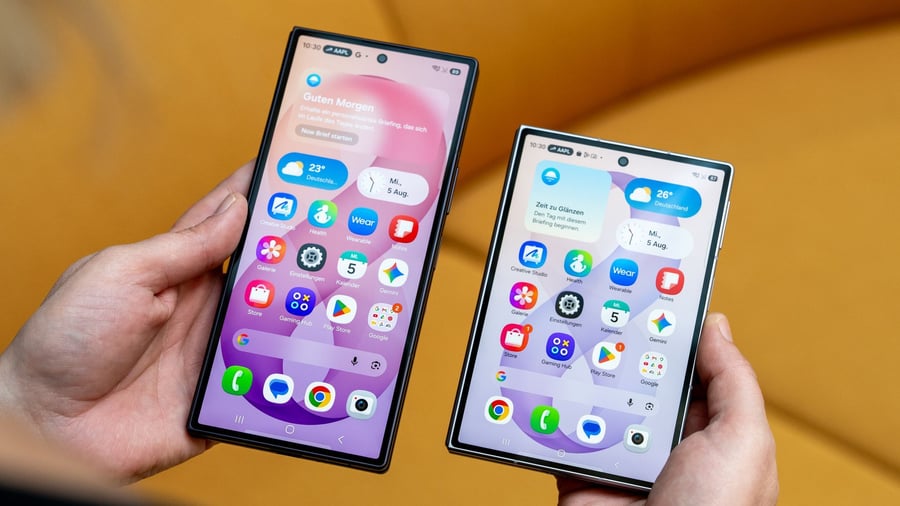
The new device is slim, wide, and light. When closed, its 16:10 aspect ratio resembles a sleek passport or a compact notebook. The outer screen measures just 5.5 inches diagonally, but its gained width makes the phone surprisingly easy to hold. One-handed typing on the screen button flows smoothly and effortlessly compared to previous models.
The new Galaxy Z Fold 8 Ultra, however, sticks to the standard lengthened design, featuring a large 6.5-inch outer display that expands into an almost square 8-inch inner screen. Users immediately notice the difference when holding the Ultra, as it's a massive multitasking device that becomes more apparent when closed. Despite its ultra-thin 4.1 millimeter thickness when open and 4.5 millimeters when closed, the compact Fold 8 stands out for its exceptional ergonomics.
At 201 grams, it is lighter than the 214 gram Ultra and easily fits into a jeans' hip pocket. Samsung's innovation in eliminating the deep crease in the middle of the flexible display is called "Titanium Flexible Display." A combination of a thin titanium foil and a titanium plate directly integrated into the display provides twenty times more stiffness than traditional polymer films, effectively supporting the fold area.
In everyday tests, this innovation proved effective; the crease is almost entirely gone visually and physically. A new anti-reflective coating further enhances this effect, minimizing distracting reflections. Interestingly, this smoothness effect is not as pronounced on the larger Fold 8 Ultra; the crease remains more visible and felt there.
The paradoxical wide-screen experience shows that despite the Ultra's larger inner display, the compact Fold 8 captures classic 16:9 widescreen videos almost perfectly. The Ultra's square display, however, leaves nearly half of its valuable screen space unused. Despite both models using the same Snapdragon 8 Elite Gen 5 chip with 12 gigabytes of RAM, the Fold 8's new silicon-carbon battery surprisingly lasts longer in real-world use.
With a whopping eleven hours and forty-three minutes, it outlasts the Ultra by almost an hour. The Ultra suffers from its enormous screen's energy-hungry demands. The camera specs raise initial disappointment for the Fold 8, as it only offers a dual-camera setup with 50-megapixel main and ultrawide lenses, lacking an optical zoom.
The Ultra, on the other hand, boasts a 200-megapixel main camera and a 10-megapixel telephoto lens. In practical tests, the Fold 8 surprisingly produces sharper and more detailed shots at medium zoom levels up to four times magnification thanks to modern software algorithms and the sensor's cropping. This is due to Samsung's decision to use a slightly older 10-megapixel sensor for the Ultra's telephoto zoom, which has become obsolete.
Only at extreme zooms of ten times or more does the Ultra's physical lens surpass the Fold 8. In normal daylight conditions, both cameras perform remarkably well, with sharp edges and vibrant colors.
Written by urgent.news from Handelsblatt's reporting — not their text. Machine-written — may contain errors; check the original before relying on it.