Why Spiro deployed 22,000 electric motorcycles in Rwanda but only 5,000 in Nigeria
Rwanda, with about 13 million people, hosts more than four times as many Spiro motorcycles as Nigeria, whose population exceeds 200 million. It is also the company's largest operation across its six African markets
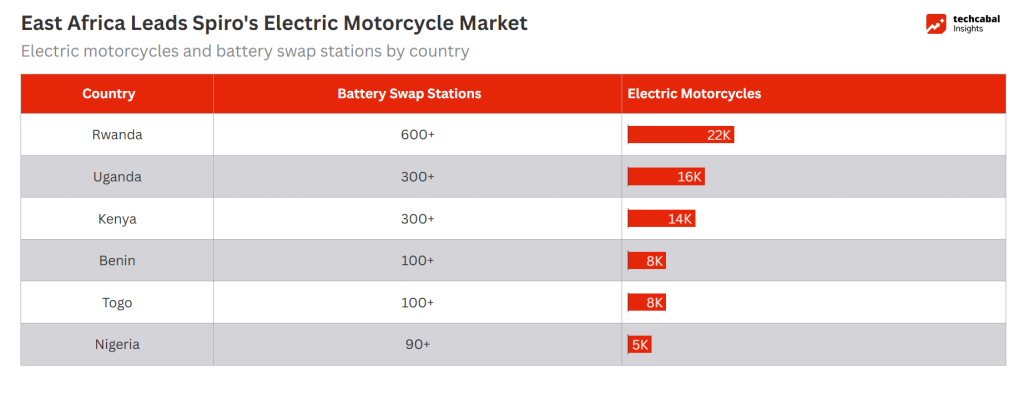
By the end of 2025, electric motorcycle company Spiro had deployed approximately 22,000 electric motorcycles in Rwanda and around 5,000 in Nigeria, according to the company's inaugural Sustainability Report. Despite Nigeria's significantly larger population, the disparity in Spiro's deployment raises questions about the company's market selection strategy.
Rwanda, the company's largest operation and home to 13 million people, hosts over four times as many Spiro motorcycles as Nigeria, which has a population exceeding 200 million. The figures reveal that Spiro's expansion choices prioritize factors besides pure population size, including government policy, infrastructure, manufacturing potential, and battery swap economics.
Spiro's CEO Anant Badjatya attributes Rwanda's lead to earlier market entry, supportive government policies, and extensive infrastructure investment. The Rwandan government has actively supported electric mobility through import duty relief and urban policy measures in Kigali, which enabled Spiro to accelerate infrastructure development.
In contrast, Nigeria's complex market requires a more gradual approach, focusing on building industrial capabilities alongside motorcycle and battery swap station deployment. Spiro's resource allocation reveals a significant difference between the two markets: Nigeria requires more staff per motorcycle, reflecting the company's need to invest in local assembly, battery recycling, and other industrial capabilities.
While Rwanda has matured in Spiro's operations, Nigeria requires further development in these areas. Badjatya emphasizes that Rwanda's success stems from well-aligned policy, infrastructure, and economics, rather than a one-size-fits-all model. The company acknowledges that Nigeria's customer behavior, riding patterns, and market dynamics necessitate a tailored approach, including local assembly and battery recycling initiatives.
As the most mature market, Rwanda will focus on expanding capacity through high-throughput Mega Stations in the coming years. Nigeria, meanwhile, aims to solidify its foundational infrastructure before pursuing similar expansion. Spiro's ambitions extend beyond its current six markets, with plans to enter Cameroon, Tanzania, Ethiopia, Malawi, Mali, and the Democratic Republic of Congo.
The company's strategy hinges on identifying markets with strong mobility demand, supportive policies, favorable rider economics, and robust infrastructure, complemented by industrial potential and a dense battery-swapping network.
Written by urgent.news from TechCabal's reporting — not their text. Machine-written — may contain errors; check the original before relying on it.