Super-Earths May Be Solid Deep Inside Their Mantles
New estimates show that a mineral likely common in these rocky planets’ interiors is resistant to melting, even at high temperatures.
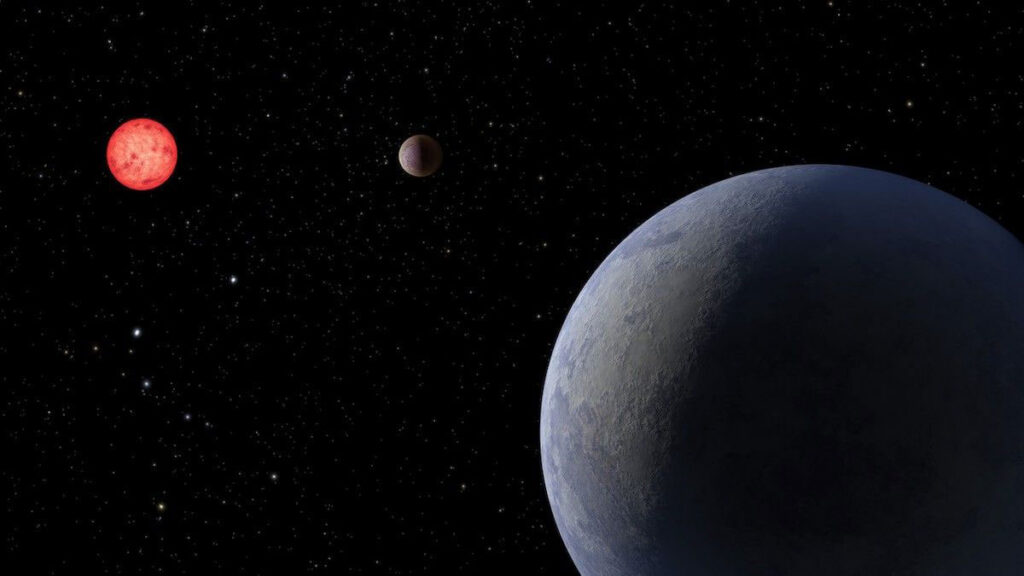
Super-Earths, rocky planets with masses between one and ten times that of Earth, harbor mysteries within their deep mantles. High pressure alters familiar minerals into forms seldom observed on Earth. One such mineral, magnesium orthosilicate (Mg 2 SiO 4), transforms into different crystal structures under increasing pressure. Near Earth's mantle, Mg 2 SiO 4 forms the spinel phase.
Under even greater pressures, as in massive rocky planets termed super-Earths, it rearranges into post-post-spinel, a stable crystal structure. This ultrahigh-pressure phase is presumed to be a major component of super-Earths' deep mantles, influencing their formation and evolution. Due to the difficulty of recreating the intense temperatures and pressures in a lab, researchers Zheng et al. turned to computational analysis.
Employing thermodynamic integration, they investigated the melting curve of post-post-spinel Mg 2 SiO 4 up to 1,300 gigapascals of pressure. Their findings reveal that post-post-spinel Mg 2 SiO 4 is highly refractory, capable of withstanding extreme temperatures before melting. Depending on pressure, it melts between 9,780 K and 14,897 K, significantly hotter than related minerals, including bridgmanite and MgSiO 3 postperovskite, the high-pressure form of bridgmanite near Earth’s core-mantle boundary.
Even when iron, a common component in exoplanets, is introduced, the melting point of post-post-spinel Mg 2 SiO 4 remains above the temperatures estimated for deep mantles of most rocky planets. These results suggest that many super-Earths likely possess solid deep mantles, impacting convection patterns and magnetic fields within these planets.
Written by urgent.news from Eos's reporting — not their text. Machine-written — may contain errors; check the original before relying on it.