Sharpest-ever images of the sun reveal tiny plasma whirlpools scientists have chased for decades
The patterns match what physicists expect from Kelvin-Helmholtz instability, a shear-driven effect seen in many fluids and plasmas but not previously resolved at such fine scales on the sun's visible surface. The results are detailed in a new paper in Nature, based on the telescope's 4-meter (13 foot) mirror and... Read Entire Article
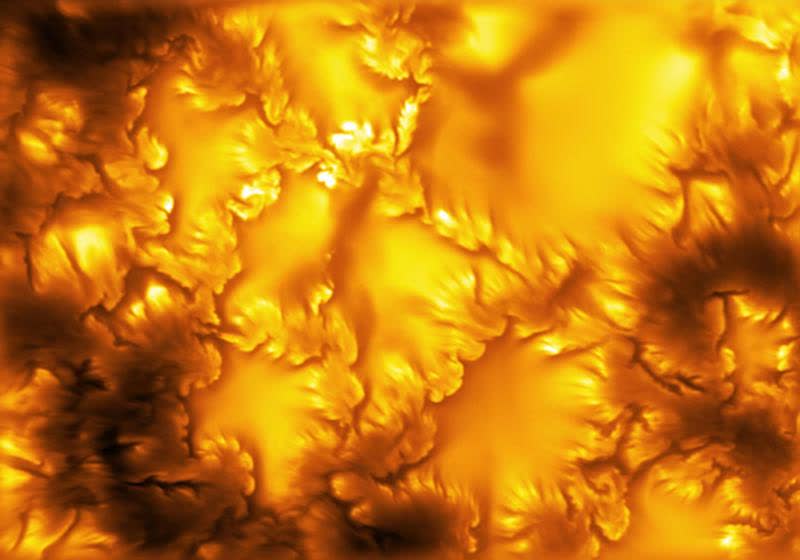
Scientists have captured unprecedentedly detailed images of minuscule whirlpools of magnetized plasma on the sun's surface, providing crucial insights into long-standing questions about energy storage and release. Utilizing the NSF's Daniel K. Inouye Solar Telescope on Maui, an international team achieved the highest-resolution solar photosphere images to date.
These images revealed dense fields of tiny vortex-like structures along magnetic region boundaries, matching theoretical predictions of Kelvin-Helmholtz instability. This shear-driven effect, observed in various fluids and plasmas, had been predicted but never directly visualized at such fine scales on the sun. Located near sunspots, where convection cells and magnetic fields are concentrated, these vortices span between 50 and 65 kilometers across, confirming their authenticity.
Resembling natural phenomena like ocean waves or cloud formations, they arise from fluid layers moving at different speeds, creating shear interfaces. Through comparisons with sophisticated simulations, researchers verified the structures' existence and equivalent spacing and motion. The implications extend beyond local observations, suggesting these vortices may significantly influence the diffusion of magnetic fields, potentially influencing the sun's 11-year magnetic cycle.
They could also contribute to models of the sun's magnetic dynamo and energy distribution, impacting predictions of solar activities like flares and coronal mass ejections, which pose risks to technology on Earth.
Written by urgent.news from TechSpot's reporting — not their text. Machine-written — may contain errors; check the original before relying on it.