Metal Detectorists Thought They'd Hit the Jackpot When They Discovered a Gold Bracelet Dating to the Bronze Age. Then They Dug Up Two More
At first, Andy Crammond thought the object was a bull's nose ring. Other artifacts unearthed nearby include a Viking brooch, a Roman coin hoard and a Bronze Age ax head
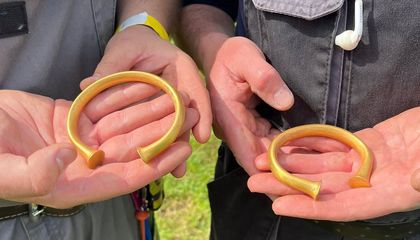
In late May, a group of metal-detector enthusiasts gathered near Carlisle, England, for a rally. Their primary objective was to promote a local infrastructure project, but they also aimed to find historical artifacts. Throughout four days of surveying 470 acres of land, the detectorists discovered hundreds of items, including a Viking brooch and a coin from 1817 featuring the image of British King George III.
However, the most significant finds were three gold bracelets, or torcs, dating back to the Bronze Age. Scottish resident Andy Crammond initially believed the first torc he unearthed was a bull's nose ring but quickly realized it was a "too shiny to be a bull ring." His friend Alan Daniels, 48, also joined in the discovery and together they found two more bracelets.
Jim Morris, an archaeologist at the University of Lancashire, described the torcs as "spectacular" and noted that finding complete ones is rare, with three complete torcs being even rarer. The torcs, weighing 18.3 ounces in total, are estimated to be worth over $400,000. Experts at the British Museum are currently evaluating the artifacts to determine if they qualify as "treasure," which would make them available for museum acquisition with proceeds shared among the discoverers and landowner Richard Forbes.
Bronze Age Britons typically wore torcs around their necks or wrists, with scholars debating whether the accessories served as symbols of power and wealth for high-status individuals or communal possessions associated with roles, rites, or offices. Many torcs discovered by archaeologists show signs of heavy use and repair, leading researchers to believe some may have been passed down as family heirlooms.
The metal-detectorists, who started detecting together for fun several years ago, had never found anything valuable before until now. A local protest group had invited Daniels, Crammond, and other members of Lothian Relics Metal Detecting to search the area to gain a better understanding of its history. The land they were searching on could soon be home to the United Kingdom's largest substation as part of the Cross Border Connection project.
Residents have expressed concerns about the project, arguing it would hinder economic growth, damage wildlife habitats, and disrupt daily life in the rural community. The metal-detector finds, however, have given the community hope, with Harty suggesting that a designated protected area should be established to preserve the historical artifacts, preventing them from being built upon and destroyed.
Written by urgent.news from Smithsonian's reporting — not their text. Machine-written — may contain errors; check the original before relying on it.