Argentina financing crisis triggers new wave of protests
Two years after the collapse of research funding in the country, scientists are protesting against the government's omission in reinstating cut scholarships and increasing salaries, as required by a 2025 law. The scientific community in Argentina is taking to the streets—once again. Part of the faculty and staff of universities across the country went on a six-day strike on April 27 and plans to march on May 12 to the Casa Rosada, the presidential palace, in Plaza de Mayo, Buenos Aires, to protest against the deterioration of salaries and the federal government's cuts in science funding.
This will be the fourth march in defense of education, public universities, and national science since April 2024. “We're living under a regime that devalues science, culture, and the scientific system,” says Daniel Tomsic, an associate professor of neuroscience at the University of Buenos Aires, who participated in the strike and plans to attend the march.
In his 30 years at the University of Buenos Aires, he adds, “I've never seen a crisis like this.” At the end of 2023, shortly after taking office, the government of Argentine President Javier Milei began freezing funding for scientific research as part of a broader effort to reduce the country's deficit and inflation. Since then, the salaries of researchers and other public university staff have suffered a 30% to 40% real decline, according to the Ibero-American Center for Research in Science, Technology, and Innovation (CIICTI).
“The scientific community has been treated abusively,” says Amaicha Depino, a professor of biodiversity and experimental biology at the University of Buenos Aires. But despite the obstacles and lack of funding, “we're survivors; we continue trying to do the best science possible.” Faculty and researchers are leaving the country, and the National System of Science, Technology, and Innovation— the entire network of public and private institutions responsible for scientific research—has lost more than 6,000 professionals since December 2023, according to a May report by CIICTI.
The funding crisis has caused an exodus of young scientists—especially graduate students—from academia; they have left in search of jobs outside the country, in the private sector, or even outside the scientific field, says Tomsic. “Even entry-level positions [elsewhere] pay more than they would receive here.” On December 4, 2025, the Argentine government announced that it would not allocate any public resources to scientific research in 2026 unless the project had a private partner and focused on agribusiness, energy and mining, or health.
The share of the federal budget allocated to science and technology could fall by half, from 0.3% in December 2023 to 0.147% in 2026, representing a historic low, according to a CIICTI report published in April. After months of back-and-forth, federal courts suspended last week the implementation of a 2025 law that establishes inflation-adjusted salary increases for university employees and the resumption of scholarship funding.
The National Interuniversity Council, which represents Argentina's public universities, appealed the decision and called for this year's demonstrations. A similar protest last year drew more than 1,000 researchers from across Argentina. Tomsic and other University of Buenos Aires faculty members have been on intermittent strike since the start of classes in March, he says.
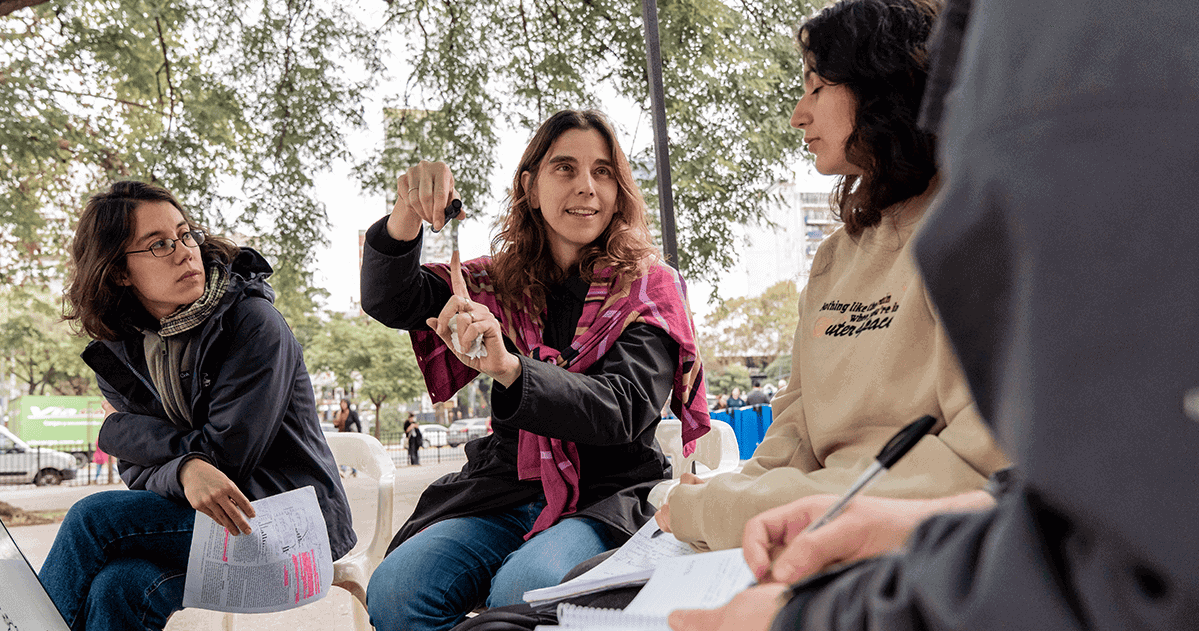
During the stoppages, they suspend all teaching and administrative activities but continue conducting some research and giving public lectures in Plaza Italia, Buenos Aires, he adds. Milei's government argues that private companies should fund science, says Mariano Belluscio, a CONICET researcher at the Institute of Physiology, Molecular Biology, and Neurosciences at the University of Buenos Aires.
Before being elected president, Milei proposed privatizing the National Council for Scientific and Technical Research (CONICET), the main employer of researchers in Argentina's public science system. But this argument shows that “the government does not fully understand how the scientific system works—that you need a bit of everything for it to evolve,” says Belluscio.
Companies are struggling to meet demand because a very large number of researchers are applying for their funding, he adds. A private company that previously granted Belluscio a scholarship limited applications to clinical and translational work because it received an excessive number of proposals, the researcher reports. As a result, some research areas are falling behind due to lack of funding, says Depino.
“We're waiting for the storm to pass to decide how to proceed,” she says. “But if this situation drags on for much more than four years, it will be very difficult.”
Translated by urgent.news. Machine-written — may contain errors; check the original before relying on it.