Commentary: After Ceuta, Europe is once again mired in migration chaos of its own making
The latest episode is partly a reflection of disagreements and lack of coordinated action in Brussels, say these academics.
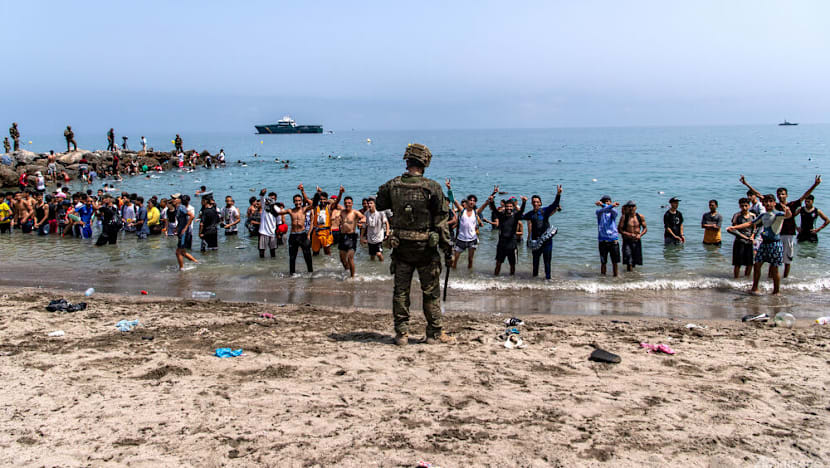
Europe finds itself once again ensnared in the tumultuous debate surrounding immigration. European interior ministers convened for an EU-wide emergency session on borders after a staggering 70,000 people crossed from Morocco to Ceuta, a small Spanish enclave on the North African coast. The exodus left 88 individuals dead within 48 hours, with many attempting to evade the heavily fortified border by swimming in the Mediterranean.
Spanish far-right politicians seized upon the incident, exploiting it to advance their anti-migrant agenda. However, this crisis is not an isolated occurrence. The 2015 migration "crisis" left a bitter taste in the mouths of many Europeans, as it threatened to destabilize the bloc. Once again, the root of the problem lies not solely in the sheer number of migrants or misinformation, but rather in the disagreements and lack of coordinated action within the European Union.
The disparities between Morocco and Ceuta - starkly illustrated by the GDP per capita gap of US$4,153 in Morocco compared to US$26,774 in Ceuta - have fueled discontent among Moroccans, particularly in the north. Many cite a lack of job opportunities and educational prospects as reasons to seek a better life in Ceuta. From January to April 2026, nearly 3,000 migrants crossed to Ceuta, with around 1,000 seeking asylum.
The recent surge in crossings was largely attributed to misleading rumors spread online about a recent Supreme Court decision, which purportedly allowed Spain to refuse return of migrants who arrived by sea. Many migrants were reportedly inspired by these social media posts, which suggested they could swim to Ceuta and eventually travel to Europe for better prospects.
The Spanish court decision was grappling with a complex legal issue, and drew parallels to a similar debate in the US Supreme Court regarding pushbacks at the southern border.
This latest crisis bears the hallmarks of the 2015 "crisis," reminding Europe of the long shadow cast by the massive influx of migrants in 2015. Some EU countries even suspended the Schengen zone, which allows for the free movement of goods and people across 29 European countries, reinstating border checks. The European Council attempted to address the issue through a mandatory quota for sharing refugee burdens, but the proposal fell apart in acrimony and discord when Hungary, Poland, and the Czech Republic refused to participate.
Written by urgent.news from Channel News Asia's reporting — not their text. Machine-written — may contain errors; check the original before relying on it.