Unprecedented images may explain one of greatest mysteries of the sun
Highest-ever resolution pictures of our star could help show why its corona is millions of degrees hotter than its surface Golden bands and swirling vortices have been spotted on the sun in the most detailed images ever captured of the turbulent surface of our home star. Astronomers observed the sun with the Inouye solar telescope in Hawaii, the world’s most powerful solar telescope, and saw new…
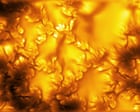
Unprecedented images from the Inouye solar telescope in Hawaii have revealed new details on the sun's turbulent surface, potentially explaining the mystery of why its outer atmosphere, the corona, is millions of degrees hotter than its surface. Captured by the telescope with a resolution finer than 20km across, the images show small whirlpool-like structures known as Kelvin-Helmholtz instabilities (KHIs).
These KHIs form when fast-moving plasma slides past slower-moving fluid, creating shear at the interface, leading to the growth of small disturbances that evolve into spiralling vortices. While similar phenomena have been observed in Earth's lakes, oceans, and atmospheres, as well as in the atmospheres of Jupiter and Saturn, their existence on the sun had never been confirmed.
The findings, published in Nature, suggest that KHIs could be responsible for the braiding of magnetic field lines, a process that ultimately powers explosive events on the sun, such as solar flares, jets, and coronal mass ejections. These events can disrupt power grids, satellites, GPS positioning and global communications on Earth.
By understanding the sun's magnetic fields and the role of KHIs, scientists hope to unravel one of the greatest mysteries of solar physics and astrophysics, potentially explaining the heating of the sun's corona.
Written by urgent.news from Guardian Science's reporting — not their text. Machine-written — may contain errors; check the original before relying on it.