Drought: Dry Germany: Why it is so dry at the moment
Where water normally flows, dry, dusty ground can currently be found in many places: In many rivers and lakes there is as little water as hardly ever before - and the situation could worsen.
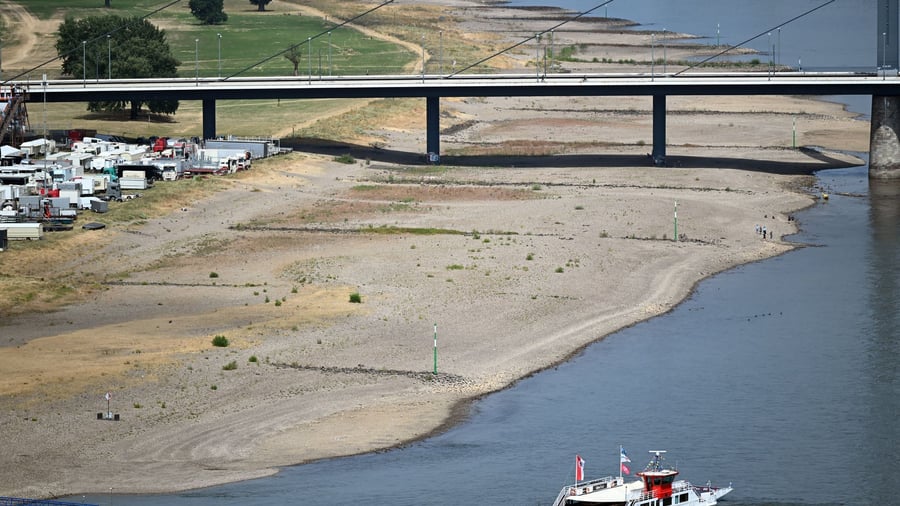
Due to the Rhine and Danube rivers having as little water as they rarely do, plants and trees are craving moisture and we humans also need a lot of fluids on hot days like these. Water has become a precious commodity, although Germany is actually considered to be rich in water. Is the country drying out? Here are the most important questions and answers.
How dry is it - and how unusual is it?
"We are currently experiencing an extreme drought," emphasizes Markus Weitere from the Helmholtz Centre for Environmental Research in Leipzig (UFZ). Currently, the south of Germany is particularly affected, as well as the Rhine's source in Switzerland. This is noticeable at the levels of the Rhine and Danube rivers. "These are two rivers that are very, very severely affected. We have extreme low water, in some cases already with historical lows."
In the drought monitor operated by the UFZ, you can see how, in particular, the south of Germany has been getting progressively redder over the course of the past 14 days. In this case, this indicates that there is increasingly less water available in the deep soil layers.
Martin Helms from the Federal Institute for Hydrology (BfG) speaks of an "exceptional situation with extreme water levels, in some cases below the known lowest water levels". All major rivers - especially the Rhine, Danube and Elbe - are simultaneously severely affected - and this is already at an early point in the summer. The typical low-water season is usually only in late summer or autumn.
According to forecasts, the situation is unlikely to ease in the coming weeks.
Why do the rivers currently have so little water?
The ecologist Weitere from the UFZ explains: "It's a combination of factors that are coming together. It's very warm and we have relatively little precipitation. This means that on the one hand, little water comes in and on the other hand, a lot evaporates due to the high temperatures."
Another factor is that "we had an exceptionally dry spring. And that has also led to the fact that we now have a situation where there is little water in the groundwater stores."
A further aspect is the changed snowmelt, which affects Lake Constance, for example. "Usually, we had meltwater runoff there until summer, which contributed to a good water supply for Lake Constance and the Rhine. This effect has decreased significantly."
In the past winter, less snow fell than the long-term average, according to the German Weather Service, although there were large regional differences. Overall, the winter was too dry, sunny and mild.
How critical is the current situation?
"The situation is quite critical. Nature is suffering greatly, small water bodies and marginal areas of rivers, i.e. important floodplain ecosystems, are drying out. But it is also critical for the economy. On the Rhine, ships can no longer carry full loads in some cases. Supply chains are being disrupted and in the end, this is also reflected in economic value creation," says Weitere from the UFZ.
Regional showers and thunderstorms do not provide a really sustainable remedy, but only a temporary increase in water levels. "Overall, the continuing downward trend predominates," according to the BfG.
What about our drinking water?
"The drinking water supply is still secure in Germany," emphasizes Weitere. The majority of it comes from groundwater. In addition, drinking water extraction has a high priority over other uses. "Nevertheless, there are local bottlenecks, which are countered by restrictions on use." For example, the city of Munich recently banned filling private pools or sprinkling lawns.
Groundwater in deeper soil layers is fed by precipitation, as the Federal Environment Agency explains. Prolonged drought therefore also leads to changes here, although these occur more slowly. In the dry years 2018, 2019, 2020 and 2022, the groundwater levels in near-surface aquifers have fallen significantly, according to the Federal Environment Agency.
Environment Minister Carsten Schneider (SPD) said in July to "Spiegel": "In the future, we will have serious conflicts over water - also in Germany." The Federal Republic has so far been a water-rich country. "But that is changing."
And what about the quality of the water?
Looking at unwanted substances in water bodies, Helms from the Federal Institute for Hydrology explains: "The concentrations can increase with low water, which can also become problematic. Another problem is the temperatures. If they rise above 25 degrees, it also becomes problematic with oxygen."
On the Moselle, the development of health-damaging blue-green algae has already begun. The habitat for organisms in the water is also being restricted.
Do we have to expect drought every summer now?
"If we look at the trends and forecasts, then we have to assume that much of what we are currently seeing will become a new normality. It won't look exactly the same as now, but it is to be expected that the intensity and duration of summer heat phases will increase," says Weitere.
It will be critical if several events come together - for example, a dry spring with a hot summer. "That is something we are increasingly experiencing and to which we must adapt."
More frequent and severe heatwaves and increasing droughts are a consequence of climate change. A warmer atmosphere can absorb more moisture, which is why longer dry periods are increasing. The BfG also assumes that climate change will lead to low-water events becoming more intense in the long term, because more water evaporates.
How can we adapt to the increasing extremes?
The ecologist Weitere explains: "The big question is: How do we spread water availability over the year? Can we store water better? We have to think about new strategies."
Translated by urgent.news. Machine-written — may contain errors; check the original before relying on it.