Sandbox Testing for API-Heavy Systems: What Changes When You Don’t Own the Dependency
Sandbox testing works well when your team controls both sides of the integration. You define the service, you define the mock, you know exactly what the sandbox should return. That setup holds up fine for internal microservices and first-party APIs. It starts to break down when you don’t own the dependency. Payment processors, identity providers, […]
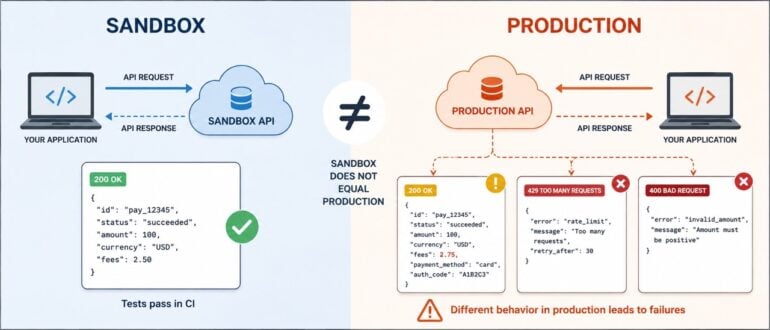
When your team does not control the other side of an integration, sandbox testing becomes less reliable. Services like payment processors, identity providers, SMS gateways, and shipping integrations are dependencies your system relies on but cannot fully replicate. Providers offer sandbox environments, yet these are simulations and not exact mirrors of production. The discrepancy between sandbox and production environments is where production incidents often originate.
Teams rely on sandbox testing by writing integration tests against third-party sandboxes, betting that the sandbox accurately reflects production behavior. However, this bet frequently fails as sandboxes lag behind production due to factors beyond teams' control. New fields in webhook payloads appear in production before being documented in sandbox environments.
Rate limiting logic operates differently across environments, error codes surface in specific production failure scenarios without sandbox equivalents, and authentication token formats change quietly in production while the sandbox continues to return the old structure.
Maintaining perfect sandbox parity is costly and often deprioritized by providers in favor of shipping product features. The consequences manifest in test suites that pass in CI but behave differently upon deployment due to sandbox drift. Tests validate behavior against an environment that diverged from production months prior, unbeknownst to the team.
Tests pass in CI, a deploy goes out, and something in the real integration behaves differently from what the sandbox returned, leading to weeks-long investigations to uncover the discrepancy.
Underneath the sandbox drift problem lies a set of distinct issues surfacing when external dependencies are involved. Request and response shape validation is the most fundamental layer. Does your code correctly handle the response structure provided by the provider, including optional fields, null values, and edge-case formats?
Sandboxes assist here when current but fail when they fall out of sync. Error path coverage is often inadequate in sandbox-based test suites. Tests need to exercise scenarios where payment APIs return 402, identity providers time out, webhooks arrive out of order, and more. Provider sandboxes vary greatly in their ability to support failure simulation, with many focusing solely on the happy path.
Behavioral consistency over time is not addressed by sandboxes, which only validate whether your code handles today's API response correctly. A stable test baseline is needed to detect if a change to your codebase broke previously working functionality.
State management is another area requiring more attention. Integrations sometimes create side effects within the provider's environment, such as records, events, or audit logs, which carry over between test runs. Provider sandboxes handle state management inconsistently, making it easy to isolate test state or reset between runs in some cases but leaving others with shared state leading to intermittent failures. These issues often go undetected due to a lack of clear indicators in test output.
Teams that reliably test API-heavy systems share common practices rather than relying on superior sandboxes. They don't treat sandbox environments as their regression baseline. Instead, sandboxes serve as tools for exploratory testing, validating new integrations before production deployment, and performing smoke tests after provider updates.
They capture real API interactions and use them as test fixtures, replaying actual responses during CI to ensure a stable baseline controlled by the team. Tools like Keploy, Hoverfly, or WireMock in recording mode help by anchoring tests to observed behavior rather than simulated behavior. When providers update their APIs, teams deliberately update their fixtures, aware of the changes, rather than hoping the sandbox will generate the necessary scenarios.
They version-control their mocks and fixtures alongside their code, making fixture updates deliberate code changes with clear commit messages. This approach allows for easier diagnosis when issues arise, as the history of fixture updates is readily available. Contract testing, using tools like Pact, runs tests against the actual provider API or a stub maintained by the provider, validating the agreement between your code and the provider's response shape.
While contract testing is valuable, it is not a replacement for comprehensive sandbox testing that addresses the unique challenges posed by external dependencies.
Written by urgent.news from DevOps.com's reporting — not their text. Machine-written — may contain errors; check the original before relying on it.