Inside LoopTroop: A Local Open-Source AI Orchestrator
Discover how LoopTroop uses LLM councils, Ralph loops, context engineering, and git worktrees to manage complex AI coding projects.
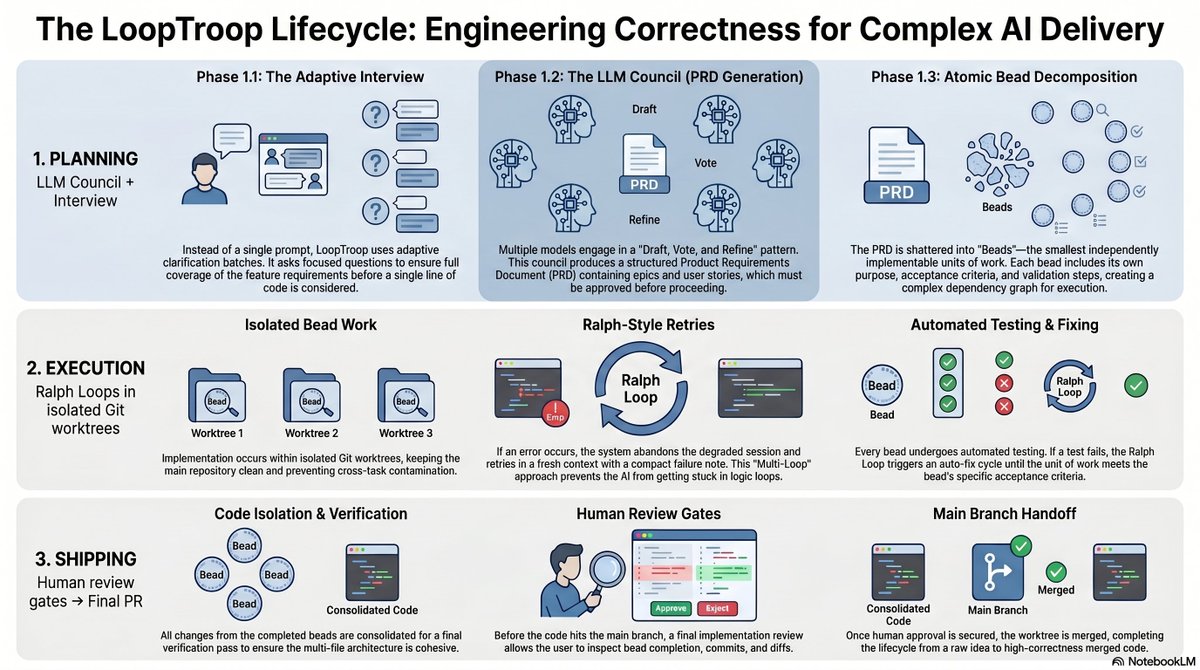
In the early days of 2023, LoopTroop emerged as a local, open-source GUI orchestrator developed by an individual who was determined to solve the challenges of complex feature development in their own applications. LoopTroop utilizes OpenCode, as well as several backends, to create new applications or enhance existing ones. The project's philosophy emphasizes getting things right over rapid shipping, drawing inspiration from tools like Lovable and Replit.
The journey began with a significant wall encounter, as the creator struggled to add meaningful features to their apps using conventional IDEs. This led to a decision to combine Ralph loops with an LLM council and a full development lifecycle, ultimately aiming to create a solution for the real problems faced in software development. The creator estimated the project would take a month to six weeks, but found themselves working on it for months instead.
The initial 120 hours were devoted to thorough planning, during which they analyzed similar projects, interacted with various AI models, and iterated on their plan. They consulted numerous models, including Chinese open models, and constantly refined the plan based on feedback. Once the plan was solidified, they delved into the tech stack, experimenting with different harnesses like GitHub CLI, Claude Code, Codex, Droid, and others, while refining their approach based on the output from each model.
LoopTroop's implementation spanned several months, with the creator relying on a diverse range of AI models, such as Codex Pro, Copilot, Claude Opus/Sonnet, OpenCode Go, Antigravity, Kilo, and OpenRouter. They also consulted top models like GPT-5.5, MS Copilot, Z.ai GLM, Qwen, Minimax, Grok, Gemini, Deepseek, Kimi, Xiaomi, and sometimes Mistral or Ernie, to gather insights and avoid potential pitfalls.
The creator emphasizes the importance of investing time in initial planning and running the plan through various models to catch different perspectives. They recommend using the strongest model available for the first iteration and settling into a continuous development loop, where complex work can be handled with LoopTroop, while smaller tasks can be addressed using more budget-friendly options.
LoopTroop's development process is ongoing, with updates and improvements being made in tandem with marketing efforts. The creator encourages others to approach building AI-driven applications with a realistic understanding of the time and resources required. The demo video provides a glimpse into LoopTroop's capabilities, showcasing its potential to streamline complex development processes.
Written by urgent.news from HackerNoon's reporting — not their text. Machine-written — may contain errors; check the original before relying on it.