Ceuta and the EU: the fair of hypocrisies
The crisis turns into a theatre of falsehoods, misrepresentations and opportunism that, to varying degrees, involves many of the protagonists.
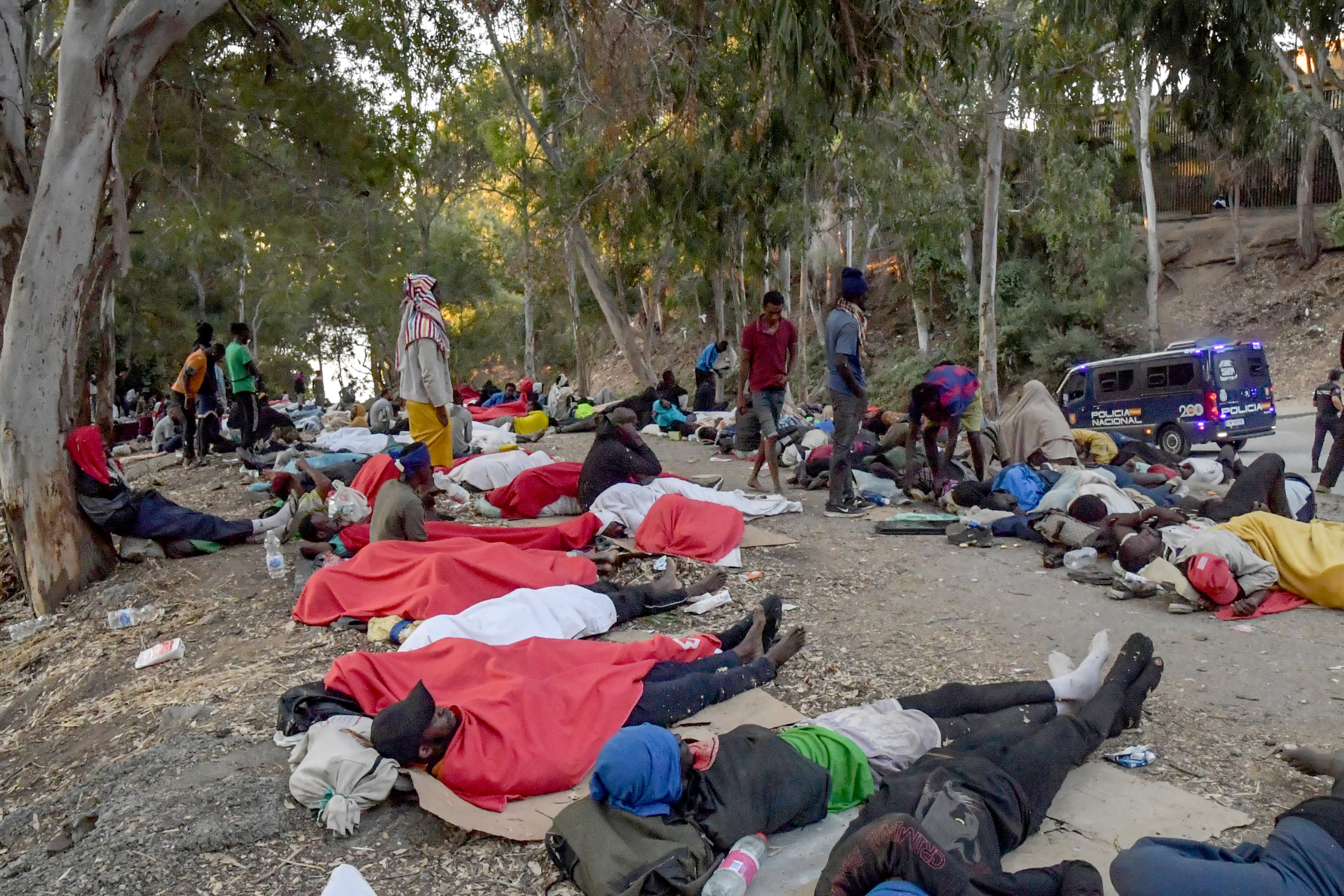
The Ceuta crisis is a fair of hypocrisies. With different intensity and gravity, almost all the actors involved resort to falsehoods or misrepresentations. Politics is never a garden of immaculate truths, but this one is especially muddy. The first responsible party is obviously Morocco, which by action or omission has unleashed a very serious crisis with dozens of innocent deaths that should weigh heavily on its conscience.
In line with the usual opacity of an authoritarian regime, it has issued partial and incongruous communications with the reality of the facts. The epitome of hypocrisy lies in the phrase that Morocco guarantees that "it will continue to be a reliable and responsible partner". The writer Tahar Ben Jelloun, in the Moroccan media Le360, dared to point in the precise direction: "On Thursday, on my way back from the Throne Festival, I saw these aspirants to exile walking with determination. The Moroccan police did not intervene".
On the Spanish side, there are also hypocrisies. The Spanish Government talks about an attack on the territorial integrity of Spain, but carefully avoids pointing to the central responsible party for the episode. Obviously, it eludes it - just like community authorities and other leaders - because, if it did so, a crisis with Rabat would open with uncertain and especially serious consequences for Spain.
The Executive has pointed to mafias that deceive people and traffic in human beings. The explanation is, at the very least, unconvincing. There is also not much coherence between how the Government defends international law and denounces the illegality of Israel's occupation of Palestinian territories and how, on the other hand, it has embraced the Moroccan solution for the Sahara, leaving the self-determination referendum by the wayside.
On the Spanish side, there are also serious hypocrisies on the part of the PP, which, for example, laments that the Executive broke the historical common position on the Sahara, while it has carried out two legislatures with blatant obstructionism that prioritizes everything - including the good of Spain and Europe - the desire to throw out Sánchez.
With this PP, state policies are practically impossible. It denounces the regularization of immigrants, when the Aznar Government did the same. It stigmatizes the Government's lack of principles, but buys the shameful national priority of Vox because, in order to pursue its real priority, recovering power, it does not hesitate to park principles.
The list of hypocrisies outside the migratory sphere is also very large. In the European dimension, very notable hypocrisies have emerged. Firstly, on the part of the Meloni Government, moved by overacting due to its internal weakness. Hit by the defeat in the referendum on the judicial reform, by the rise of a retired general - Vannacci - even further to the right than her, and by the difficulties in reforming the electoral law, Meloni felt that a theatrical blow was necessary to consolidate herself.
She activated the Schengen exception when the vast majority of migrants arriving in Ceuta immediately returned to Morocco, and for those who did not, there is no record of transfers to the Peninsula. Ceuta, moreover, is not part of the Schengen area. It does not seem credible that anyone is going to arrive in Italy. Meloni has recorded the success of 21 Governments subscribing to the letter she sent to Brussels, but the reality of the facts leaves her in a less comfortable position than it seems.
From Von der Leyen onwards, many in the EU have been collecting cable after realizing an excessive and deviated reaction. The meeting of EU Interior and Justice Ministers on Tuesday is in the direction of putting the mute button on. Secondly, there is the hypocrisy of Denmark, which has rightly sought European solidarity for the threat to Greenland, and of other Eastern and Northern partners who demand it in the face of the Russian challenge, but in this circumstance, they have opted for a merely partisan calculation.
Let's repeat: partisan, because it is neither in the national nor European interest. No, Spain is not the greatest supporter of Ukraine and refuses to raise its military spending to 5% of GDP, as the rest have assumed - another thing is if they will all do it, another hypocrisy is coming -, but it cannot in any way be accused of being an unsolidary country.
Yes, it contributes to supporting Kiev and joint security, and it is a constructive European partner.
There are reasons to disagree with the massive regularization of undocumented people, but this should not have led to a selfish political act that damages a partner and the whole common project. Is there a direct relationship between regularization and the massive entry of migrants into Ceuta? No, according to the EU Migration Commissioner, from the EPP, admitted on Tuesday.
Is there a risk of a significant transfer of those arriving in Ceuta to other countries? No. Are there significant security risks? There are no rational elements to believe it. So why the Schengen farce? For unconfessed political calculations: to ride the wave of migration toughness to gain votes and inflict a blow on a Government that distances itself from some consensuses, and sometimes provokes irritation by doing so.
In some of those cases, it provokes it because it reveals other people's shame, such as examples of submission before Netanyahu or Trump. And in that sense, more hypocrisies can be pointed out.
From Italy, for example, it has been pointed out as one of the reasons to reactivate Schengen controls, the requirement to avoid terrorist risks. A laudable objective. But it can be intuited that more than the migrants who remain in Ceuta, the danger comes from illegal and disproportionate military operations that foster resentment and hatred, and against which many maintain a culpable submission.
The devastation and collective punishment that Israel has imposed in Gaza in response to Hamas's terrorist attack will undoubtedly foster lasting hatred; the illegal action against Iran has not ousted its despicable regime, but has hit a girls' school and damaged infrastructure. Some European governments have reacted with excessive and deviated measures to the events in Ceuta, moved by inconfessed political calculations.
Translated by urgent.news. Machine-written — may contain errors; check the original before relying on it.