Amazon canopy bridges enable 15,000 wildlife crossings without a single roadkill
Founder’s Briefs: An occasional series where Mongabay founder Rhett Ayers Butler shares analysis, perspectives and story summaries. Roads through Brazil’s forests divide primate habitat and sometimes force animals that normally remain in the canopy onto the ground. Researchers in the Amazon are testing rope bridges that allow them to cross above traffic. Eight bridges were […]
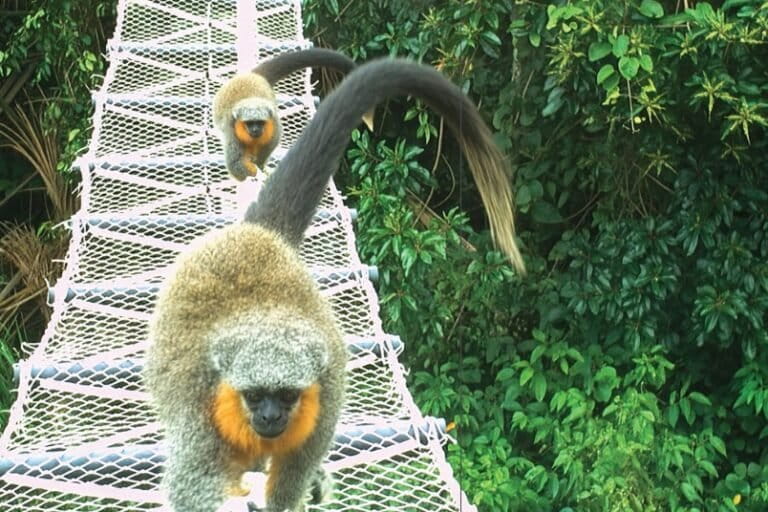
A new initiative in Brazil’s Amazon rainforest is helping to reduce roadkill among wildlife by creating rope bridges that allow arboreal animals to cross above traffic without descending to the ground. In Alta Floresta, a town in northern Mato Grosso state, eight bridges were installed in 2024, leading to the observation of 15,000 crossings by species like black-faced black spider monkeys, Schneider’s marmosets, and the critically endangered Alta Floresta titi monkey over the following 15 months. Remarkably, no roadkill was reported at the monitored sites.
These bridges are designed with multiple layers of rope to accommodate various forms of animal movement, including walking, swinging, or using prehensile tails. The structures allow for a range of species to utilize them, from those that simply walk across to others that prefer to swing or utilize their prehensile tails. Cameras have captured instances of both successful crossings and animals that approach and then retreat, suggesting that some species may need time to become accustomed to the new crossing methods.
The project in Alta Floresta is part of a larger initiative that began in 2021 along the BR-174 highway, which runs through the Waimiri-Atroari Indigenous Territory. In this region, 32 bridges have been installed, with the assistance of the local Waimiri-Atroari community in selecting optimal sites. Camera traps have logged around 1,250 primate crossings in this area over the past five years, providing valuable data on the effectiveness of different bridge designs.
The issue of roads dividing wildlife populations and reducing gene flow underscores the importance of such wildlife crossings.
Written by urgent.news from Mongabay's reporting — not their text. Machine-written — may contain errors; check the original before relying on it.