A composer published a paper on theoretical physics. His lack of credentials drew criticism.
Some people compose music or make YouTube videos for a hobby. That’s Brandon Yates’ job — so in his spare time, he tries his hand at theoretical physics. But his only published paper was questioned because of his lack of professional training in the field — despite the physicist who inspired his work saying the … Continue reading A composer published a paper on theoretical physics. His lack of…
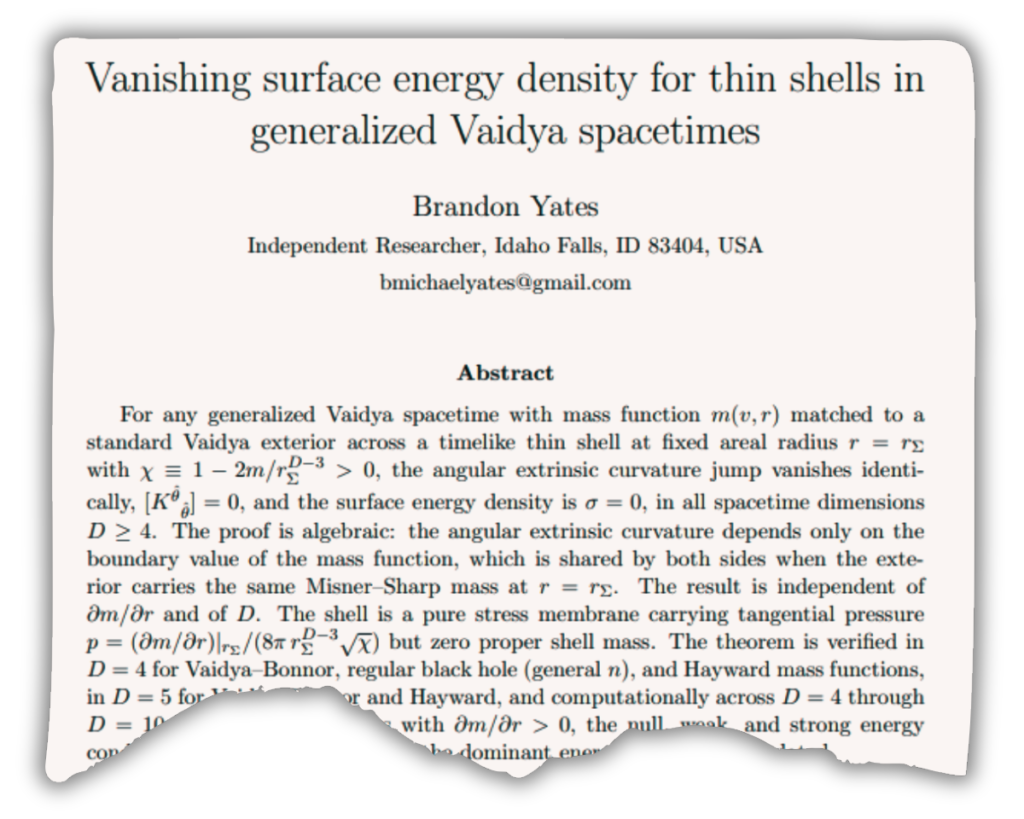
Brandon Yates, a composer for the animated series "Death Battle," has published a paper on theoretical physics despite lacking formal training in the field. His paper, which explores rules in general relativity used to combine two spacetimes across a thin shell, was published in the International Journal of Geometric Methods in Modern Physics on June 20.
Yates told Retraction Watch that he received only minor "presentational" edits from peer reviewers. After posting on X for an endorsement to upload the paper to arXiv, a physicist expressed concern about Yates' lack of formal education in STEM fields. The physicist claimed the work appeared to be produced using AI, citing his amateur background.
Yates responded by admitting he used a generative AI tool, but stated the AI was only used to assist with phrasing, LaTeX formatting, and creating a Python verification script. He emphasized that the mathematical claims were supported by exact symbolic verification materials and did not rely on AI output. The journal's co-executive editor, Francesco Bajardi, stated that while the journal could not confirm the manuscript's entirity was written by AI, the lack of affiliation and background was suspicious.
However, acclaimed physicist Eric Poisson, whose work inspired Yates, dismissed any major AI involvement, stating the paper described a straightforward exercise in applying junction conditions in general relativity. Yates is now pursuing online courses to gain proper accreditation and is actively seeking a mentor in the field.
Written by urgent.news from Retraction Watch's reporting — not their text. Machine-written — may contain errors; check the original before relying on it.