World's highest frozen lake shatters along disputed border between China and India — Earth from space
A 2024 astronaut photo shows the icy surface of Pangong Lake breaking apart in the lofty Tibetan Plateau. The point where the ice meets the water almost perfectly matches a disputed border between China and India.
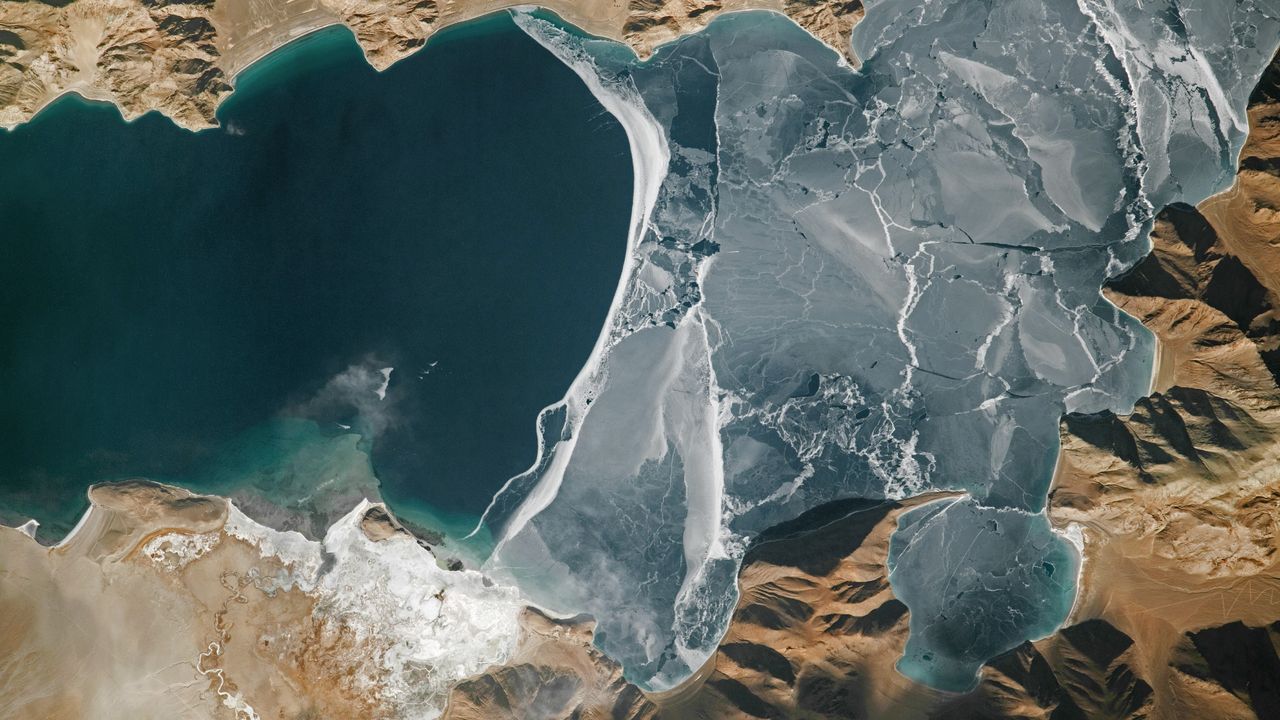
A striking image captured by an astronaut aboard the International Space Station on January 25, 2024, revealed the fractured surface of Pangong Lake, the world's highest frozen lake, perched atop the Tibetan Plateau. The lake, known in Chinese as Pangong Tso, stretches 83 miles (134 kilometers) across the disputed border between China and India, traversing the region of Ladakh, which is under Indian administration, and Tibet, an autonomous region of China.
The lake's altitude of 13,862 feet (4,225 meters) makes it an extraordinary geographical feature in the lofty Himalayas. NASA's Earth Observatory notes that the lake is endorheic, meaning it has no outflow, leading to an unusually high salt concentration that typically prevents it from freezing. However, the extreme cold temperatures in the region, reaching down to minus 13 degrees Fahrenheit (minus 25 degrees Celsius), are sufficient to allow the salty water to freeze over.
Despite its high salinity, Pangong Lake has been known to partially freeze over from December to February. The stark image illustrates the ice's fracture along the disputed border, where the Line of Actual Control is located. The border, established in 1959 and solidified in 1962 after the Sino-Indian War, has been the site of frequent skirmishes between the two nations.
Despite the ongoing tensions, Pangong Lake continues to attract tourists, particularly birdwatchers, who come to observe large flocks of bar-headed geese and Brahminy ducks that breed in the area. The lake's unique landscape also includes ancient shorelines left over from when it had a higher water level, now exposed as parallel striations along the frozen surface.
Written by urgent.news from Live Science's reporting — not their text. Machine-written — may contain errors; check the original before relying on it.