Why $100 in Your 20s is Worth $500 in Your 60s
What if I told you that $100 at 25 is worth $500 at 65, even after we adjust for inflation? Well...it is. There's an unspoken belief in personal finance that a dollar is always worth a dollar (putting inflation aside). We assume that spending $100 today would bring the same amount of joy as spending $100 (inflation-adjusted) in the future. But it won't. Why? Because of how we experience time as…
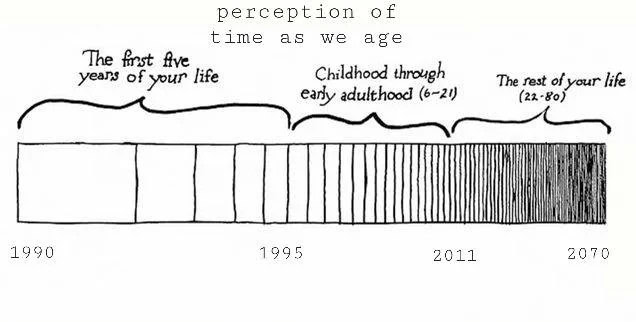
The age-old belief in personal finance that a dollar is always worth a dollar, aside from inflation, is not entirely accurate. This assumption overlooks the fact that our perception of money and experiences changes as we age. French philosopher Paul Janet proposed in 1877 that our subjective perception of time is proportional to our age, leading to the notion that time appears to pass faster as we get older.
Younger individuals experience time more slowly due to living less life than older people. This phenomenon, known as Janet's Law, explains why perceived time increases with age, making each additional year seem more significant to younger generations.
However, the reminiscence bump, or enhanced memory of ages 10-30, suggests that we recall our early years more vividly than our later years. Adjusting Janet's Law to account for the reminiscence bump, researchers found that a year in one's 20s represents 1/10th (10%) of their memorable life, while a year in their 60s represents 1/50th (2%) of their memorable life. This adjustment reveals that the 20s occupy 5 times more perceived life than the 60s.
The implications of this insight for financial decision-making are profound. As time seems to occupy more of our perceived lives during our 20s, spending money during this period should be worth 5 times more to us in terms of experiential value. Our early adult years are when we form our identities and create memorable experiences, which contribute to our overall well-being.
Consequently, the money spent during our 20s provides a higher experiential return, making it a crucial period for financial investments that can yield significant long-term benefits.
However, this realization should not lead to an uninhibited approach to spending. While experiences in our 20s are valuable, saving and investing earlier can provide substantial long-term advantages. A 4% real inflation-adjusted return on investments in our 20s can equate to having $500 in our 60s, considering the inflation-adjusted value of a $100 spent in our 20s.
Therefore, striking a balance between spending in our 20s for experiences and investing for the future is essential to maximize both immediate and long-term happiness.
Written by urgent.news from Of Dollars and Data's reporting — not their text. Machine-written — may contain errors; check the original before relying on it.