Strange Asteroid May Be the First Known With Three Lobes and Its Own Moon
Learn more about (44) Nysa, one of the brightest asteroids in the belt between Jupiter and Mars, which has its own moon and three lobes.
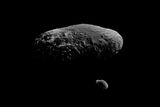
Astronomers have discovered a peculiar asteroid, (44) Nysa, which may be the first known to possess three distinct lobes and an accompanying moon. This captivating discovery was made possible through advanced telescope data, specifically from the Large Binocular Telescope in Arizona and the European Southern Observatory's Very Large Telescope in Chile.
The asteroid, first observed in 1857, is known for its bright enstatite-like surface composition, making it one of the most luminous asteroids in the solar system. However, its true shape and structure remained elusive until recent observations.
Recent images revealed two large valleys across the asteroid's circumference, dubbed "colli" by the research team, which are neck-like connections between separate lobes. These observations suggest that (44) Nysa could be a contact trinary asteroid or an extremely irregular body unlike any previously seen.
Combining SHARK-VIS images with global observations, the team constructed a 3D model of the asteroid, which showed a remarkable three-lobed structure connected by the colli. This finding could provide valuable insights into the asteroid's formation, with two leading theories suggesting it either formed through low-velocity re-accumulation of fragments or as the aftermath of a "hit-and-run" collision.
In addition to its unique shape, the asteroid is accompanied by a small moon named S/2026 (44)1, which is approximately half a mile in diameter and orbits about 100 miles from (44) Nysa. By analyzing the moon's velocity and orbit, researchers aim to better understand the asteroid's mass and density.
These findings could help place (44) Nysa in a category of celestial objects whose shapes may preserve evidence of past collisions and mergers, shedding light on our solar system's history.
Written by urgent.news from Discover Magazine's reporting — not their text. Machine-written — may contain errors; check the original before relying on it.