Migration: EPP leader Weber on Ceuta crisis: Spain must change course
Today, EU interior ministers want to discuss the consequences of the migration crisis in Ceuta. Spain is under pressure.
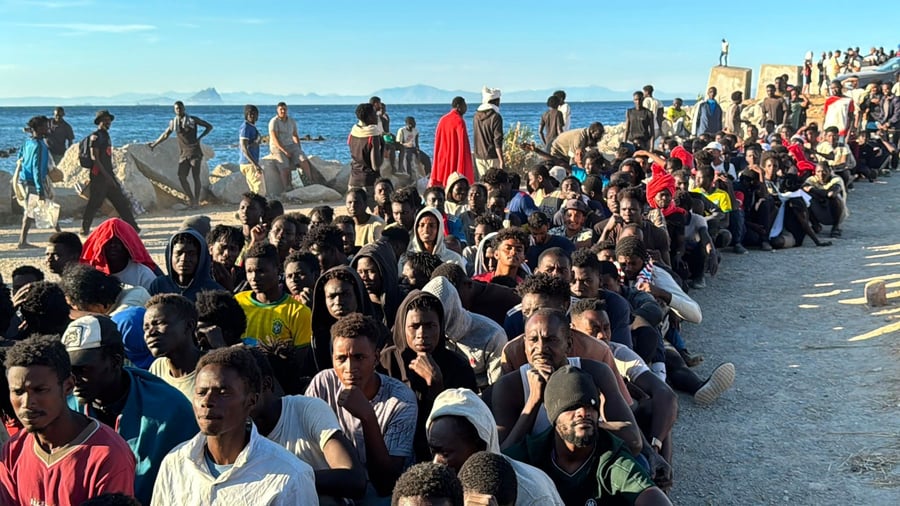
Just before the EU interior ministers' consultations on the migration crisis in the Spanish enclave of Ceuta, pressure on Madrid is increasing. Manfred Weber, the CSU's European politician and head of the European People's Party (EPP), called on the Spanish government in the "Bild" newspaper to change its migration policy. The EU interior ministers want to discuss via video conference this morning (10:00 am) how the EU can better protect its external borders.
Last week, up to 60,000 people temporarily reached the Spanish enclave from Morocco. The majority of EU heads of state and government subsequently criticized Spanish migration policy. In response, the Spanish government accused other member countries of politically exploiting the crisis. According to the central government in Madrid, the vast majority of migrants have since returned to Morocco.
The number of remaining migrants is estimated to be around 2,500. The situation remains particularly tense for unaccompanied minors. At the same time, the accommodation and return of remaining migrants, as well as the search for further victims, continue in Ceuta. According to the Interior Ministry in Madrid, 72 bodies have been recovered so far.
Austrian Interior Minister: outsourcing asylum procedures Weber told the "Bild" newspaper: "Spain must change its course." The broad support for the protests against the government of Prime Minister Pedro Sánchez and his solo actions showed that "the left-wing Sánchez government is isolated." Weber accused Sánchez of election campaign calculations and said: "Ceuta also shows us that uncontrolled immigration increases the number of victims.
No one had to die here." Austrian Interior Minister Gerhard Karner urged in the "Welt" newspaper to outsource the processing of asylum procedures to countries outside the EU in the future. "The legal possibilities for this were created with the EU asylum pact," he said. These words must now be followed by actions. "The goal is to prevent images like those that went around the world from Ceuta in recent days and to prevent deaths in the Mediterranean."
Meanwhile, the chairman of the parliamentary control committee (PKGr) in the Bundestag to supervise the intelligence services, Marc Henrichmann (CDU), did not rule out a hybrid attack on the EU as the cause of the migrant influx. "One cause could be the tensions between Spain and Morocco, which Morocco is now reacting to, as in 2021, with a controlled influx," he told the Redaktionsnetzwerk Deutschland (RND).
The government in Madrid rejected accusations that it had ignored warnings from the CNI intelligence service about a mass arrival. It said it had not received any intelligence reports warning of a migration crisis of this magnitude. The spokesman for the opposition conservative People's Party (PP), Miguel Tellado, said it was hard to imagine that the CNI had not known about the impending "wave of people."
EU Commissioner promotes unified EU EU Migration Commissioner Magnus Brunner told the German Press Agency that the events of the past week had been a stress test for the security of Europe's external borders, which Europe had passed for the time being. No one had entered the Schengen area. "Now it's crucial that the EU acts in a unified way and draws the right conclusions from these events," said the Austrian politician.
Federal Interior Minister Alexander Dobrindt (CSU) is also participating in the video conference. The EU Commission had called for cohesion before the meeting and is working to prevent any doubts about the EU migration system, which only came into force just over seven weeks ago.
Translated by urgent.news. Machine-written — may contain errors; check the original before relying on it.
Also reported by 1 other outlet
- Migration: EU interior ministers draw lessons from Ceuta crisis handelsblatt.com