Death of swan family leaves residents 'devastated'
The council says there is blue-green algae on the lake which can be damaging for wildlife.
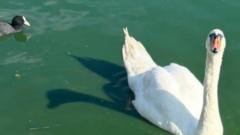
A swan family living near Canvey Lake in Essex has met a tragic end, leaving residents deeply saddened and devastated. The lake, officially designated as a Local Nature Reserve in 1998, had two resident swans who had given birth to nine cygnets this year. Unfortunately, two cygnets were killed by foxes and four others were taken to South Essex Wildlife Hospital in June, where one subsequently died from avian botulism.
The remaining three cygnets, along with their parents, were admitted to the wildlife hospital on Tuesday following concerns over the deteriorating condition of Canvey Lake. Tragically, all six birds, including the mother and father, passed away on Friday.
Martin England, a member of the Friends of Canvey Lake committee, termed the situation an "environmental disaster." Sue Schwar, the founder of South Essex Wildlife Hospital, firmly believes the deaths were caused by exposure to blue-green algae. For 50-year-old resident Hayley Cockayne, the loss is deeply personal; she had spent four to five hours daily with the swans for the past three years, always fearing the worst but never imagining it would come to this.
Cockayne, who described the lake as "dead," lamented that the wildlife had virtually vanished, with only a few birds now surviving in the contaminated waters. In July 2025, tests revealed an alarming concentration of blue-green algae at 2.5 million cells per millilitre, far exceeding the warning threshold of 20,000 cells. This alarming discovery led to Canvey Island Town Council surrendering its lease of the lake to Castle Point Borough Council.
In response to the crisis, the borough council allocated £500,000 for lake restoration efforts. The Environment Agency, managing the lake on behalf of Castle Point Borough Council, expressed deep sorrow over the loss of the swans and acknowledged the impact on local residents. They noted the presence of blue-green algae, a naturally occurring phenomenon that can develop in still water during hot, dry weather, causing harm to wildlife.
The council emphasized that similar issues, including algal blooms and wildlife impacts, had been reported across the region due to recent heatwaves and drought conditions. Restoration works, backed by £1 million in funding, are set to continue, aiming to restore the lake to its former health and vitality.
Written by urgent.news from BBC Science's reporting — not their text. Machine-written — may contain errors; check the original before relying on it.