Could tech replace firefighters in the battle against wildfires?
Tech is being used to watch for wildfires but firefighters are still needed to put them out.
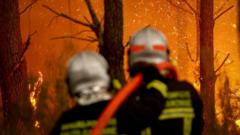
Wildfires have ravaged forests and countryside in France, Spain, and Portugal, forcing hundreds of thousands of people to flee their homes. In France alone, four firefighters have lost their lives and 150 have been injured. Chief Sergeant Guillaume Millet, with 24 years of experience, heads the Fire and Rescue Service branch of the CFDT union in the Gironde region, which has been the hardest hit by wildfires this summer.
Millet explains that while firefighting techniques have remained largely unchanged, technology for detecting forest fires has advanced significantly. Cameras assisted by artificial intelligence are now used to monitor forests and detect fire starts, replacing traditional human lookouts in watch towers. These AI-assisted cameras can accurately distinguish between smoke and dust, reducing false alarms and providing real-time video feeds and a map of the fire's location, potential spread, and expected progression based on weather conditions.
This technology has already proven its value, as FireTracking's CEO Jean-Simon Chaudier claims the system detected seven fires 15 minutes before the first phone call, saving firefighters valuable minutes in containing the fire. FireTracking's cameras currently survey a million hectares, primarily in France, at a cost of €1.2m ($1.4m; £1m) for the Indre-et-Loire département alone.
However, despite advancements in technology, Millet emphasizes that drones are not yet capable of extinguishing fires. The usefulness of technology in firefighting is limited to detection, as putting out fires still requires people to pull hoses through the forest. While French start-ups like Daidelos are developing petrol-engine drones capable of spraying water over fires, these drones are not yet able to form an autonomous first response to forest fires, and it is unlikely that technology will replace firefighters in the near future.
Written by urgent.news from BBC Technology's reporting — not their text. Machine-written — may contain errors; check the original before relying on it.