Blood Falls in Antarctica May Harbor Ancient Microbes, Preserving Traces of a Lost Ocean
Learn about the hidden microbial ecosystem that has been living within Antarctica's Blood Falls for over one million years.
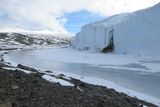
In remote areas of East Antarctica, a peculiar natural feature known as Blood Falls periodically emits an unnaturally red-orange brine. Emerging from Taylor Glacier into Lake Bonney, the saltwater is densely packed with iron, which oxidizes to a rust hue upon exposure to air, a sight easily visible even through Google Maps' satellite imagery.
Despite the desolate surroundings, this crimson spectacle might hint at a potential habitat for life. Recent research, however, reveals a complex microbial ecosystem thriving in the iron-stained ice, mud, and sediments, providing clues about the falls' ancient origins.
Published in Nature Geoscience on August 3, the study discovered a microbial community in the crimson substance at the lowest point, or terminus, of Taylor Glacier. This team of organisms predominantly consists of marine-associated creatures, despite their significant distance from the ocean. The findings support the idea that the falls are fed by an ancient pool of marine water, isolated for a long period, and highlight the remarkable resilience and adaptability of life.
During a research expedition in mid-July, the temperature in the Antarctic interior reached minus 119.4 degrees Fahrenheit, the coldest recorded since 2012. The researchers analyzed 167 samples of sediment, water, and air from the McMurdo Dry Valleys, along with a nearby ice-covered inlet. Genetic analyses of the collected samples indicated the presence of numerous eukaryotes—microbes with cells containing nuclei and other membrane-bound organelles—associated with marine environments.
More than 60 percent of the diatoms identified in the red mud and sediment samples had ancestral ties to ocean life, while some prokaryotes, single-celled organisms without nuclei or membrane-bound organelles, also showed marine ancestry. The researchers believe that periodic outflows of brine water create a habitat where marine microbes could persist.
The origin of these specific marine microbes is more likely due to ancient flooding than wind dispersal, as past research suggests that millions of years ago, when Antarctica was warmer, the ocean may have flooded its eastern region, and when the water receded, some may have gotten trapped beneath the advancing Taylor Glacier around 2.5 million years ago.
The discovery of eukaryotes with marine ancestors bolsters the theory of an ancient oceanic source for Blood Falls. Additionally, the study sheds light on the microbes themselves. The analyses suggest that some of the eukaryotes near Blood Falls possess enrichments in cellular pathways related to photosynthesis, stress responses, cellular repair, and the ability to survive in salty habitats. This evidence demonstrates that these microbes have adapted to environments vastly different from their ancestral marine setting.
Environmental microbiologist Brent C. Christner from the University of Florida, who did not participate in the study, emphasizes the significance of the findings. He states that the documented microbes have evolved strategies to survive in the dry valleys despite conditions that differ greatly from their ancestral marine setting. The study contributes to a more precise estimate of the time when the Blood Falls' brine became isolated, according to Allen.
Written by urgent.news from Smithsonian's reporting — not their text. Machine-written — may contain errors; check the original before relying on it.