Zodiacal Dust in Exoplanetary Systems Could Hinder Our Search For Life On Other Worlds
Most exoplanetary systems have a plane of dust similar to the zodiacal dust of our solar system. This dust absorbs some of the very light we use to find biosignatures in exoplanet atmospheres, and could make our search for life more challenging.
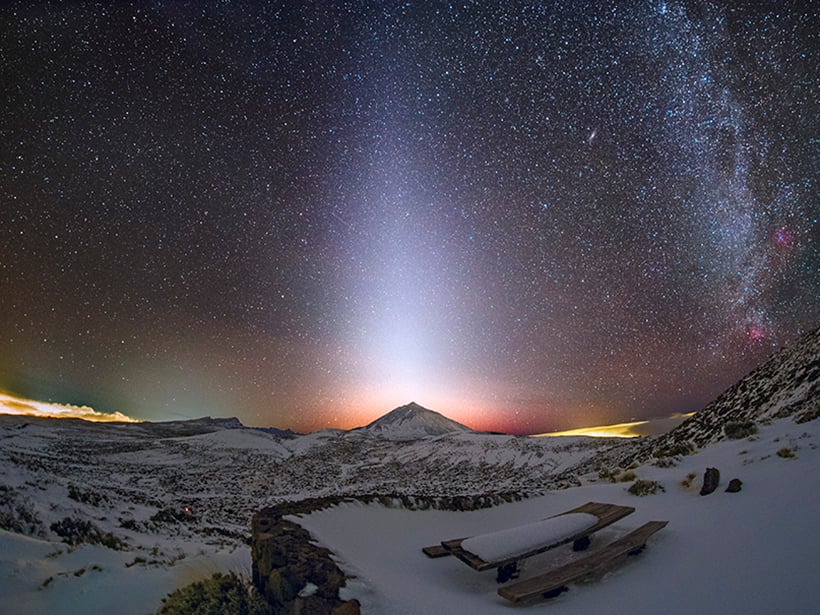
A faint glow, resembling a column of light rising from the east, can be observed in the early morning hours before dawn. This phenomenon, often referred to as the false dawn, is actually caused by dust in the inner solar system. Known as the zodiacal light, it aligns with the plane of the inner planets, hence its name. Similar zodiacal dust planes are likely present in a majority of exoplanetary systems, particularly those containing rocky, potentially habitable worlds.
The zodiacal dust can influence our search for extraterrestrial life. Astronomers look for life by examining the atmospheres of exoplanets, analyzing the absorption spectra of light as the planet passes in front of its star. Certain wavelengths of light are absorbed based on the molecular composition of the atmosphere. By studying these absorption spectra, scientists can identify molecules that may indicate the presence of life.
However, zodiacal dust can interfere with this process. It scatters a significant portion of the light, weakening the absorption spectra by up to 50%. This scattering effect becomes more pronounced at longer wavelengths, introducing a bias in the data. In most cases, the masking caused by zodiacal dust is even stronger. A survey of nearby stars reveals that the zodiacal dust in most systems is three times greater than what we observe in our own solar system.
To accurately study the atmospheric spectra of potentially habitable planets, astronomers must first determine the scattering and absorption effects caused by the system's zodiacal dust. This adjustment is crucial for obtaining precise readings of exoplanetary atmospheres. While the presence of dust does not make the search for extraterrestrial life impossible, it does necessitate more meticulous observations and data analysis.
With advancements in high-resolution spectral observations and extended observation times, the impact of exozodiacal dust on our efforts to find life on other worlds can be mitigated.
Written by urgent.news from Universe Today's reporting — not their text. Machine-written — may contain errors; check the original before relying on it.