Will new batteries give China’s EVs the jolt they need to charge past their rivals?
On a cloudy evening in late April, a tech event hosted at Beijing’s National Convention Centre by Contemporary Amperex Technology Ltd (CATL) drew nearly 1,000 people eager for a glimpse of next-generation electric vehicle (EV) batteries that could reshape the global automotive landscape. Gao Huan, chief technology officer for the auto business at CATL, the world’s largest producer of EV…
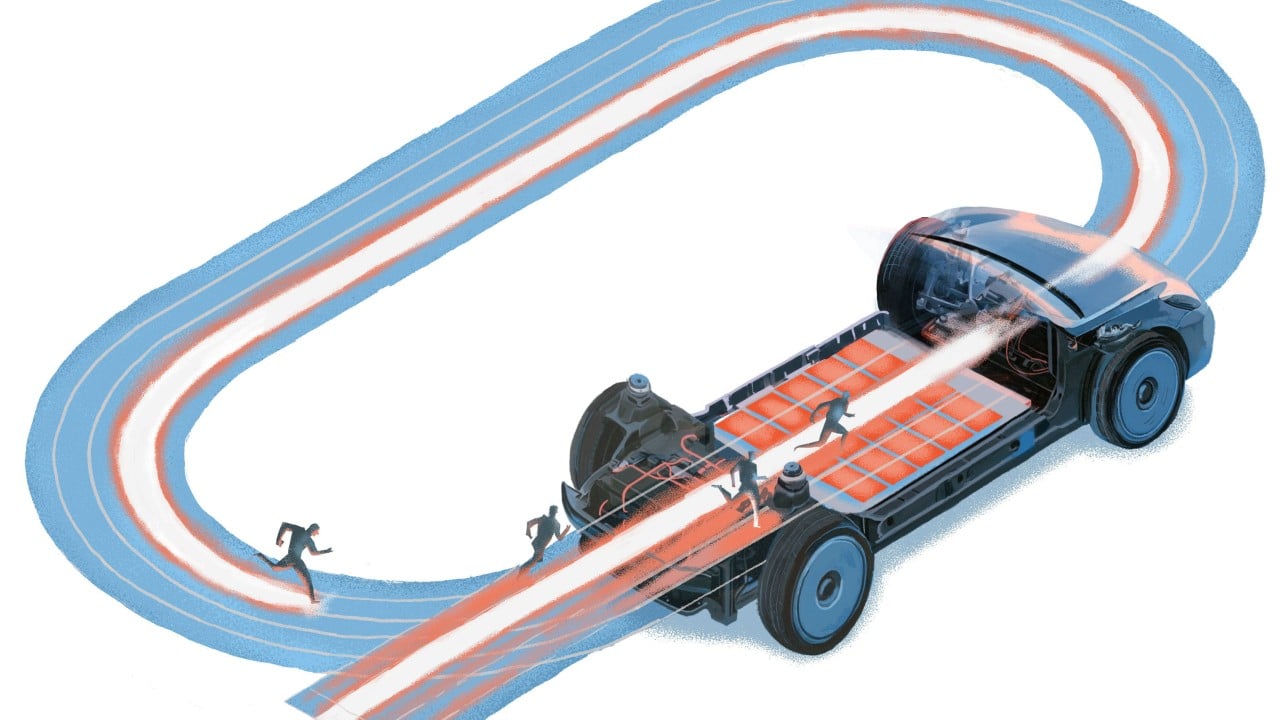
On a recent evening in Beijing, a tech event hosted by Contemporary Amperex Technology Ltd (CATL) brought together nearly 1,000 people to learn about the company's next-generation EV batteries that could transform the global automotive industry. Gao Huan, chief technology officer for CATL's auto business, confidently announced the new Shenxing product series, boasting an incredibly fast charging time from 10 to 98 percent in under six and a half minutes.
In comparison, BYD's second-generation Blade battery takes nine minutes for the same charge level. CATL's innovation lies in its ability to manage heat generated during fast charging, which can shorten battery lifespan. The company creates separate sealed exhaust channels for heat and electricity, ensuring efficient and safe operation.
With electric vehicles (EVs) becoming increasingly popular, the battery pack, which constitutes about a quarter of an EV's cost, plays a crucial role in the global shift towards electrification. As technology advances, concerns over production costs, range, and vehicle safety are being addressed. CATL's Shenxing battery series, with its record-breaking charging speed, can significantly ease consumer anxiety about range and charging time. Morgan Stanley noted that this development is a game-changer for the industry.
The global EV battery market, led by CATL with a 40.2 percent share in the first five months of 2026, saw a 16.3 percent increase in usage from the previous year to 469.2 gigawatt-hours (GWh). A GWh can power approximately 20,000 EVs with a range of 500km (311 miles). CATL's advancements in fast charging and thermal management have the potential to further drive electrification in the automotive sector.
China, the world's largest market for automotive and EVs, witnessed a 57.4 percent market share for pure electric and plug-in hybrid cars in the first half of 2026. Over the past decade, the cost of EV batteries has plummeted from US$1,474 per kWh in 2010 to US$108 per kWh in 2025, with a target of US$100 per kWh expected to make unsubsidised EVs competitive with traditional vehicles.
Chinese battery makers have a cost advantage, with prices falling by 13 percent year on year to US$84 per kWh in 2025, with predictions of a global average of US$62 by 2030.
Chinese EV battery makers, including CATL, BYD, and Gotion High-Tech, continue to dominate the global market, accounting for 72.6 percent of it between January and May 2026. While higher-performance and lower-priced batteries hold promise for the future, debates around the safety and durability of ultra-fast charging persist. Nonetheless, Chinese battery makers and their supply chain partners are continuously striving to extend the lifespan of lithium-ion batteries and explore cutting-edge technologies such as solid-state batteries to revolutionize the EV industry.
Written by urgent.news from SCMP Business's reporting — not their text. Machine-written — may contain errors; check the original before relying on it.
This story
This is one outlet's version. Read the fullest account.