The Definitive Guide to the TEX86 Paleothermometer
A new review article summarizes our knowledge of how microbial lipids archived in marine sediments record ancient ocean temperatures and outlines challenges and next steps for the TEX 86 proxy.
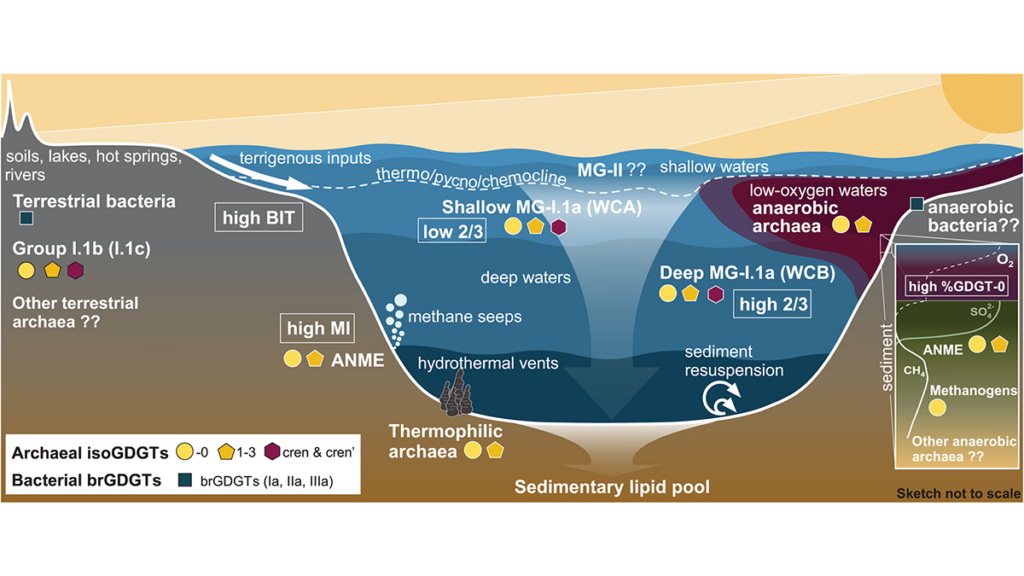
Editors' Highlights present a comprehensive review of the TEX86 paleothermometer, a tool used to estimate ancient ocean temperatures dating back 190 million years. Archaea, a diverse group of single-celled microorganisms, adjust the molecular composition of their membrane lipids in response to temperature changes. Planktic archaea, free-floating species, modify the ratio of lipids containing varying numbers of cyclopentane rings as seawater temperatures fluctuate.
In 2002, Schouten et al. developed the TEX86 index, which correlates the tetraether lipids (cyclopentane-containing lipids with 86 carbons) in archaeal membrane lipids to past sea-surface temperatures. Since its inception, TEX86 has been pivotal in reconstructing marine climates throughout Earth's history. Elling et al. (2026) provide a detailed synthesis of the current understanding of TEX86, including its origins in ammonia-oxidizing archaea (Nitrososphaeria), the mechanism behind the temperature signal, and the challenges in interpreting the data.
These challenges include the production depth, seasonality, and the impact of factors such as nutrient availability and community composition on membrane lipid composition. A key uncertainty noted in their review is the form of the TEX86-temperature relationship above 30°C, as different calibrations produce markedly different estimates.
To address these issues, the authors recommend extensive laboratory culture and mesocosm experiments, as well as the creation of more sophisticated proxy-system models that accurately reflect the factors influencing TEX86. The review highlights both the significant advancements and the remaining uncertainties in TEX86, offering a roadmap for future molecular paleoclimate reconstructions.
Written by urgent.news from Eos's reporting — not their text. Machine-written — may contain errors; check the original before relying on it.