New museum find shows nature can’t stop inventing seahorses
No one has ever seen one of these fish alive. But they are most likely still swimming in a part of the sea we hardly ever visit.
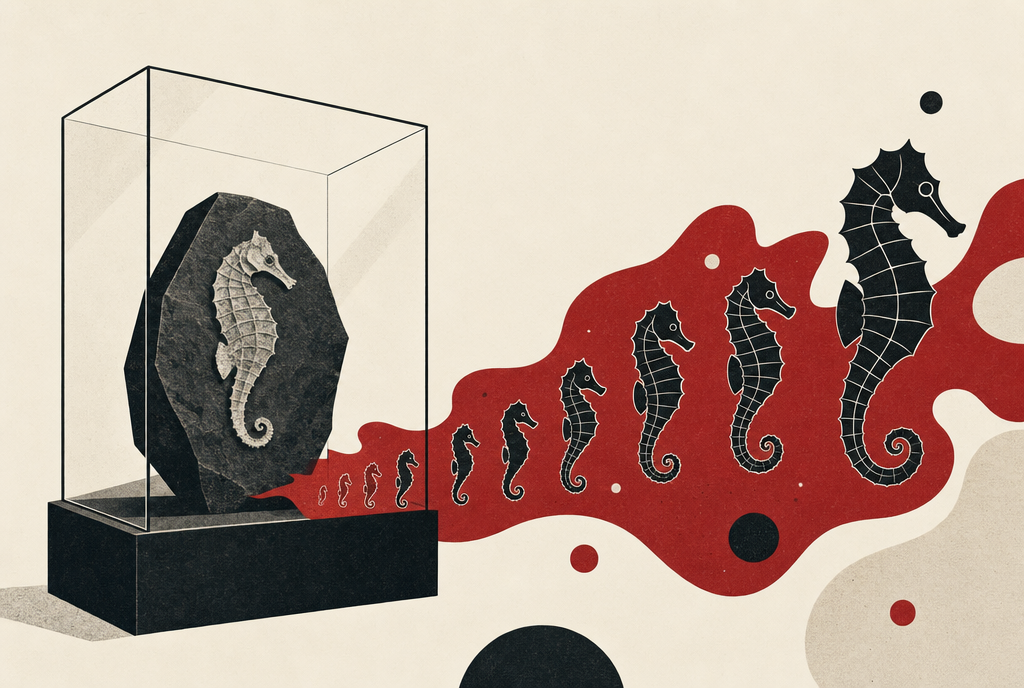
A CT scan of Australyichthys aegis, a newly discovered fish from the deep reefs off southern Australia, reveals the existence of a fish that bears an uncanny resemblance to a seahorse, with the same horse-shaped head, curled tail, and a fully enclosed brood pouch in males. However, this little fish, no larger than a thumb, is not a seahorse. This discovery has been reported in a new study published in the Journal of Lost Species.
The helmethead sea muppet, as the fish has been nicknamed due to its domed, helmet-like crest on its head, is part of a small group of fish known as the sea muppets. These three species - the bullneck sea muppet (A. minotaur) and the paradoxical sea muppet (A. paradoxus) - have now been identified as belonging to their own unique branch of the family tree, with no connection to true seahorses.
Previously misfiled in museum drawers for decades, these fish were discovered in deep reef environments between 50 and 125 meters below the surface, often as bycatch from trawling or dredging activities. Each specimen has been preserved and forgotten, with the only trace of the genus being seven specimens collected over a span of 65 years, spread across more than 2,500 kilometers of coastline.
Using micro-CT scanning, researchers were able to build three-dimensional models of each fish’s skeleton and compare them to those of true seahorses. The scans showed that Australyichthys aegis lacks several key features found in seahorses, such as a rigid cage of fused bony plates supporting the belly and a bony crown on the head. Genetic sequencing also confirmed that the fish is not a seahorse, but rather a member of its own branch of the family tree.
These sea muppets, along with their two relatives, have been placed in the seahorse genus solely based on their appearance and not on their genetic makeup. They are now recognized as lost species, known only from preserved specimens and never observed alive. This discovery highlights the importance of targeted surveys in deeper ocean zones, as these unique fish are most likely still present in areas that are rarely explored.
Written by urgent.news from The Conversation AU's reporting — not their text. Machine-written — may contain errors; check the original before relying on it.