The new giving: What does Christopher Nolan's cinematic "Odyssey" say about the present?
What does it actually mean to be civilized? The new version of Homer's "Odyssey" spans the arc from the historical catastrophe of humanity to the current debate about exclusion and hatred.
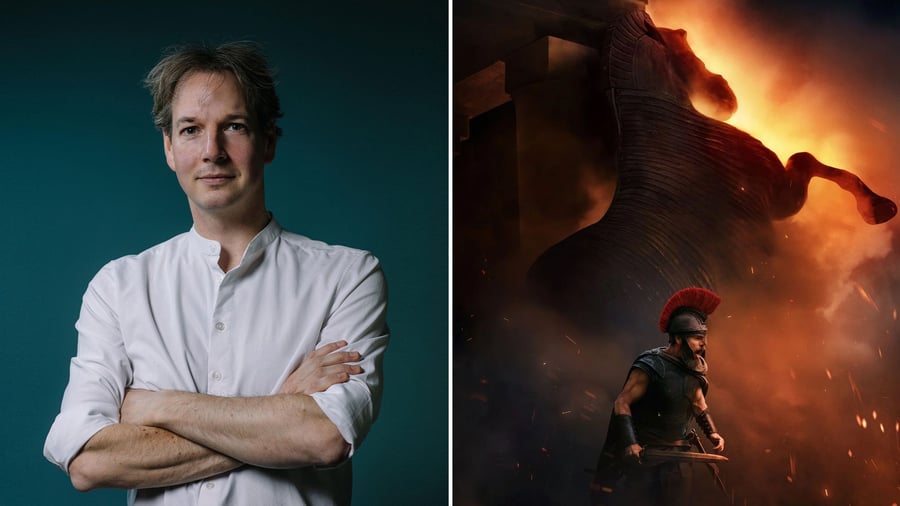
In the past few weeks, I found myself on the hill of Troy, watching videos of singers performing Homer's epics in their original language. Since then, a more accessible version has become available, reaching a larger audience and earning around 600 million dollars. After seeing Christopher Nolan's film "Odyssey," I understand why.
He brings to light what people have been concerned with for three millennia. One phrase, however, remains with me, even though it does not appear in Homer's work. In the context of this story, "Odyssey" resembles a true human catastrophe. Around 1200 BC, several high cultures of the Eastern Mediterranean were overwhelmed by mysterious "sea peoples," whose origin remains controversial to this day.
Nolan makes no effort to conceal this. His Odysseus escapes the Cyclops, resists the Sirens, and finds the needle in the haystack between Scylla and Charybdis. Above all, he stands by the protection of Zeus, a kind of golden rule: treat the stranger at your door as you would like to be treated yourself. This is the crux of the film for me: what does it mean to be civilized?
We believe we know the answer. Civilized is who can afford high culture. Similarly, the Athenians thought of themselves after the Trojan War, when they built a glorious legacy of heroes. Penelope exposes this with a single sentence. Upon Odysseus' return to Ithaca, she looks at the Greek nobles who have been torn apart by greed and asks: "Are WE the sea people?"
How will we treat the stranger? For Homer, Troy did not fall because barbarians destroyed it. It was the glorified Greeks themselves who spun a triumphant history for themselves. The status symbol is not superiority; it is hospitality, sharing with the stranger. Whosoever welcomes the newcomer demonstrates rank. Whosoever banishes him is among the robbers, regardless of the golden wreaths he may wear.
Thus, this three thousand year old story is woven into our present. The strangers whose livelihood we deny through global warming are already living today. And it is the queer people who feel insecure at a parade in their own city. The golden rule turns the focus. It asks us how we would like to be treated ourselves if we stood before the door as strangers.
Those who expel or threaten the stranger consider themselves guardians of order. Homer's sea peoples behaved like this and destroyed civilization. In a recent article dated June 23rd, I questioned how high the walls of wealth must be if more and more places are burning. A month later, smoke clouds are hovering over Europe and the United States.
After every civilizational catastrophe, humanity has once again gathered inside and quoted the best of an idealized past. Back then, Greece was still densely forested. They could negotiate with the gods of their time, but not with the current global warming. Perhaps that is why I see more people than ever before this summer, who want to do the right thing with their money.
This is certainly due to the immediate experience, the fires, and the hate that is now openly felt at home. Those who look closely at the crisis share. This sharing has an economic core. Our words "economy" and "ecology" share the same root, the Greek "oikos," meaning house. In a globalized world, the strangers are practically all at our doorstep.
We live together in one house, an ecology. Whether it remains livable for all depends on the question Penelope asks: "Are we the sea people?"
Written by urgent.news from Handelsblatt's reporting — not their text. Machine-written — may contain errors; check the original before relying on it.