Christian Lindner: "My freedom includes being in love with doing things"
For more than half a year, the former Minister of Finance has been deputy head of Autoland. Handelsblatt has been following him. How is Christian Lindner doing in his new job?
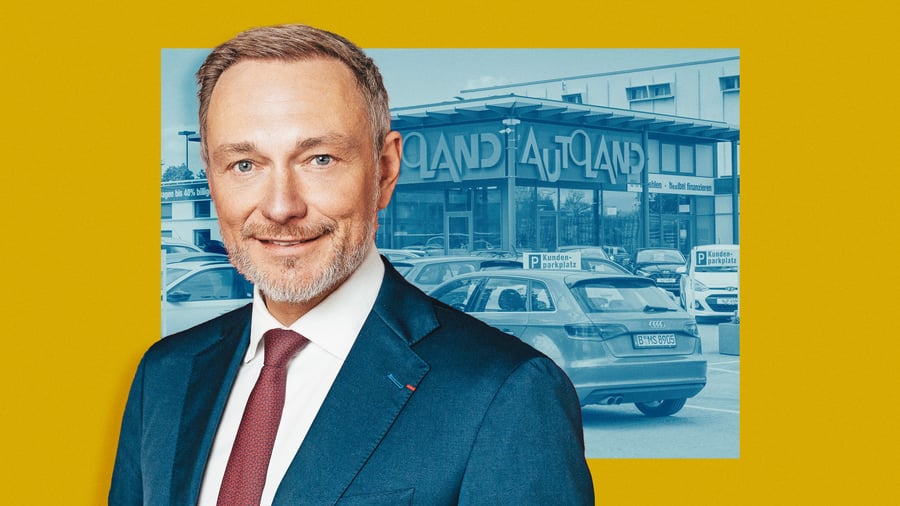
When Christian Lindner takes the stage in Rottach-Egern, he actually wants to talk about his new job: it's mid-March, and he's been the deputy head of Autoland, one of the largest independent car dealerships in the country, since the beginning of the year. But here, at the "Unternehmertag Tegernsee", an exclusive networking meeting where you can't quote from the stage program, he's mainly asked questions about his past: about the failed traffic light coalition, the struggling FDP, and his time as Minister of Finance.
Lindner, wearing a light Zegna jacket, beige shirt, and black sneakers, tries to brush off the past - and brings the company into focus, which he wants to digitalize and modernize: an operation with 1,500 employees, over a billion euros in sales, 38 branches so far, and a headquarters in Saxony-Anhalt. Brehna instead of Berlin. Boardroom instead of Ministry of Finance.
Entrepreneur instead of politician. How has Lindner managed this change so far? The Handelsblatt has observed the 47-year-old at appearances over the past few months, visited him in his new workplace in eastern German province, and inquired about him among former companions. The result is a portrait of a man for whom his public image is still extremely important - and who is repeatedly caught up by the past.
Does he really not want to go back? In his email signature, it now says: "Entrepreneur, Supervisory Board & Advisor, Investor, Federal Minister (ret.)". In February 2025, after the FDP missed the 5% hurdle in the early federal election, Lindner announced his withdrawal. After just over a quarter of a century in state and federal politics, almost twelve years as FDP leader, and three years as Federal Minister of Finance.
After the breakdown of the traffic light coalition, in which he and his FDP were not entirely innocent, much was speculated about Lindner's future. He is said to have not received any offers from DAX corporations, but at least MDax members were interested. He could also have had advisory positions abroad. Over the months, his first mandates become public: advisory board of the Hagedorn Group (construction industry), supervisory board at Serviceplan (advertising) and Lhoist (raw materials), advisor at Teneo (consulting), the Stuttgart Stock Exchange, and Stepstone (career portal).
The biggest surprise, however, is Autoland, where Lindner starts as deputy head of the board in early 2026. For Wilfried Wilhelm Anclam, who founded his company a year before Lindner was born, it's a coup: suddenly everyone is writing about his company, which was hardly known, at least in western Germany. Why did Lindner choose exactly this job?
In March, he gives his first big interview since taking office - not in the "Spiegel" or the Handelsblatt, but in the "Automobilwoche". There, you learn not only that Lindner has himself driven around in a "rolling office from Sindelfingen", but also that his plans were "different". But the vision of the Autoland founder had impressed him.
In early July, when Lindner receives the Handelsblatt in Brehna, it sounds similar: for almost 25 years, he was a politician with passion, looks back on it gratefully. "But after politics, I didn't just want to advise or represent, but take on direct responsibility for sales, personnel, and results." He now takes this over from the Autoland headquarters, a two-story clinker building with red windows and white facade panels, the company colors.
In front of the entrance, Anclam's Maybach is parked. Around it, there are dozens of buildings and open spaces, all lined with finely cut hedges. Red transporters drive cars of various brands onto huge parking areas. Here are the workshops for vehicle preparation, as well as a hall with a 360-degree photo studio, the paint shop.
A little further away, hundreds of new cars are parked in rows - one of the branches that Lindner does not call a "parking lot", like other dealers, but an "exhibition". A place where customers don't have to look for a salesperson, but are "received".
He was convinced by the "entrepreneurial freedom" that is "exceptional" here in the family business, says Lindner. "Developing a customer retention campaign, setting up a call center, introducing a new distribution system, or renegotiating a large platform contract - that's very concrete." You can see what works in the evening. "Exactly this hands-on work gives me joy."
His daily work has changed extremely: Lindner is no longer driven by politics, no longer has to be able to speak at any time of day about everything and anything. He no longer rushes from one appointment to the next, takes his time, mixes with the audience at events, seeks exchange. Previously, he often read his dossiers and the leading articles of the next day already on the previous evening.
"Today, in the evening, I don't look at social media first, but at sales, inventory, and profit." Lindner is already deeply involved in the new subject matter. Several times, he jumps up during the interview, sits down at the laptop, clicks through tables with residual values, standing times, sales statistics, calculates the 58,000 cars they sold last year - and aims for the 66,000 mark in 2026, almost half of which are new cars.
The industry vocabulary is also in place: "The car purchase is sensitive to the economy and mood," he says, for example. Or: "Whoever precisely controls inventory and demand invests less capital and reacts faster to price movements." Digitalization, marketing, sales, IT, the use of AI - all this now lies in Lindner's department.
By 2035, he wants to triple the number of Autoland locations to 120. The turnover should double to two billion euros by 2030, with the same profit margin of more than ten percent. Also vertically, he wants...
Translated by urgent.news. Machine-written — may contain errors; check the original before relying on it.