Astronomers watch a black hole's feeding frenzy end with a bad case of cosmic indigestion
Astronomers have discovered that the feeding frenzy of a distant black hole ended with a windy outburst.
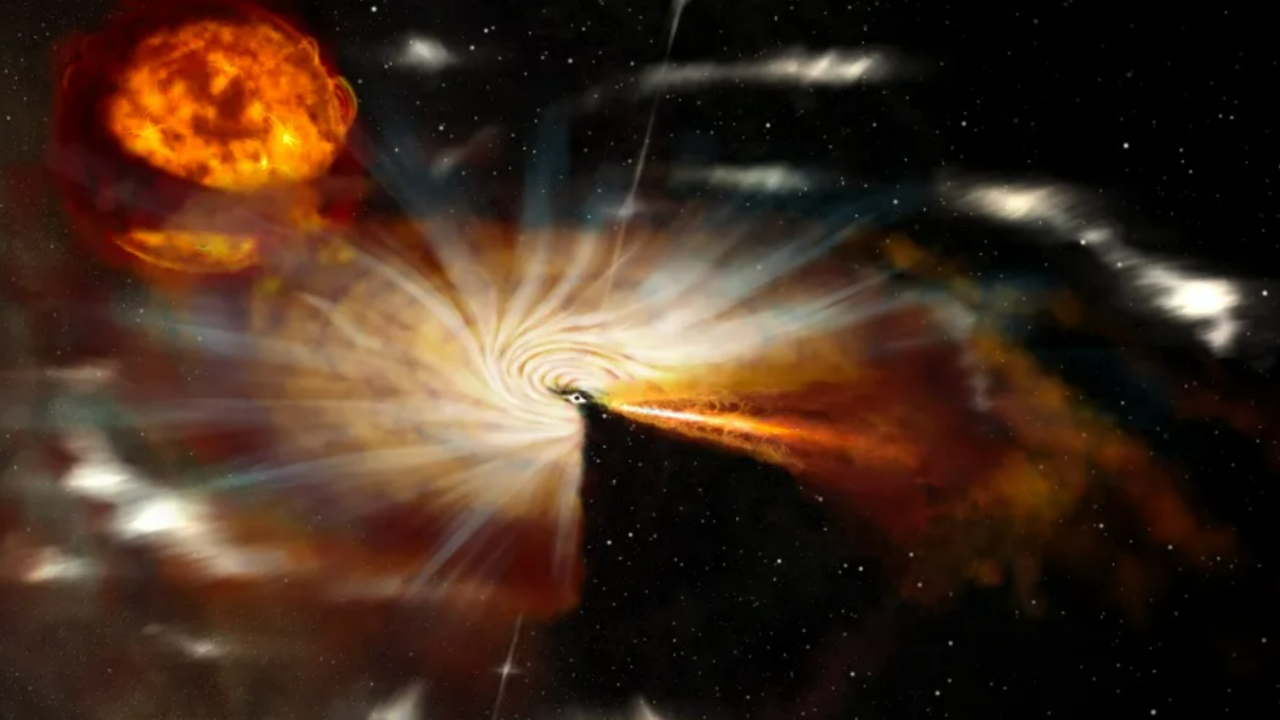
Astronomers have employed the Very Large Telescope (VLT) to scrutinize a distant black hole's outburst, unveiling a complex digestive system for these cosmic entities. The research centered on the black hole system Swift J1727.8−1613, situated approximately 8,800 light-years away. The initial discovery of Swift J1727.8−1613 in 2023 emerged from a violent episode of material feeding and subsequent X-ray emissions, leading researchers to observe the system's detailed behavior over time.
The investigation revealed that as the black hole voraciously absorbed a star's stellar material, some matter was consumed while other components were ejected as high-speed jets and powerful winds. Notably, the most substantial outflows transpired during periods of lower feeding activity, suggesting that black holes are less voracious than previously believed and possess a more intricate process akin to a cosmic digestive system.
Noel Castro Segura, the team's leader from the University of Warwick, compared black holes to "bottomless pits," but their observations paint a picture of far more complex interactions.
Accretion disks, formed from the superheated matter swirling around the black hole due to its gravitational influence, underwent alterations during the outburst, providing valuable insights into the connection between matter accretion and ejection. Furthermore, the team discovered that the black hole continued to emit dense gas winds post-feeding frenzy, implying that a significant portion of the black hole's "meal" may be expelled, challenging the notion of black holes as bottomless entities.
Researcher Kyle Solomons from the University of Cape Town emphasized that the intense finale of the black hole's feeding cycle offers a more detailed understanding of the process than ever before, disrupting the traditional perception of black holes as relentless, indiscriminate absorbers. These findings were published in the Monthly Notices of the Royal Astronomical Society (MNRAS).
Written by urgent.news from Space.com's reporting — not their text. Machine-written — may contain errors; check the original before relying on it.