Spanish North Africa enclave: Ceuta returns to normality - At least 72 dead
Open shops, laughing children on the beach: everyday scenes are playing out again in Ceuta. But possible dead bodies are still being searched for in the sea. And calm has also not yet returned to Brussels.
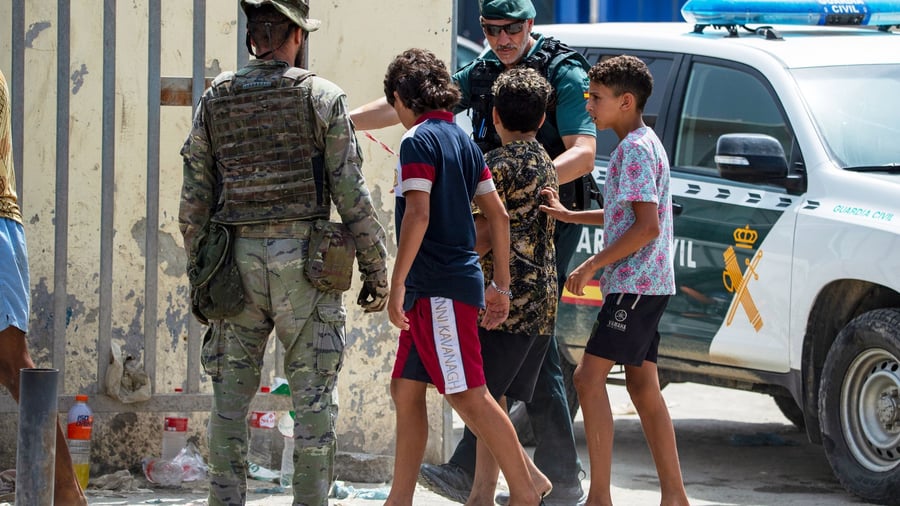
Ceuta, a Spanish enclave in North Africa, is slowly returning to normal after an unprecedented influx of migrants. Shops, cafes, and restaurants that had been closed due to chaotic scenes have reopened as people venture out on the streets, carrying shopping bags and families play with children at the beach. The Spanish government reported that most of the 50,000 to 60,000 migrants who arrived in the enclave from Morocco mainly on Wednesday and Thursday have returned.
However, 3,000 security forces remain in Ceuta for the crisis, as per the Ministry of Interior. Some hundred newcomers are still present, but the situation is calmer, with no attempts to reach the enclave by sea observed, according to a reporter from the state TV channel RTVE.
Regional President Juan Jesús Vivas, who belongs to the conservative People's Party (PP), disputes the notion that normalcy has returned, estimating that thousands remain in Ceuta. The PP leader accuses the left-wing central government of being solely responsible for the influx, describing it as an "invasion." While some Moroccans still hide, many are returning, as reported by RTVE through the words of residents.
Among them is Humad, a 20-year-old who aims to find a better life in Ceuta, as his mother and young brother who needs insulin are left behind in Morocco. His 17-year-old friend Hachim aspires to play for FC Barcelona, but the brutal reality hit him when Mohamed, just meters away from the coast, drowned. Humad could not complete the sentence about his feelings regarding the tragedy.
Authorities have rescued more bodies from the sea, bringing the death toll to at least 72. They continue to search for others. The newspaper "El País" quoted an anonymous police officer saying, "There are more deaths in the sea." Most fatalities occurred during the attempt to swim from Morocco to Ceuta through the Strait of Gibraltar.
The central government quickly acted on the promise of Prime Minister Pedro Sánchez to create an additional obstacle using an inflatable, orange barrier. The barrier, about 22 feet tall and reaching up to 3.3 feet underwater, aims to prevent migrants from swimming to Ceuta. This barrier is essentially an extension of the land border fence in the sea, according to the Ministry of Interior.
The barrier, reinforced by a chain of buoys, is aimed at addressing a gap created by a recent Supreme Court ruling. The ruling states that migrants who reach Spain via an unguarded border section, such as the sea, have the right to an individual asylum claim hearing. Therefore, an outright rejection is only permissible after they have overcome a fence or other border barrier.
In the EU, the debate around external border protection intensifies, with the expectation that the EU Commission will give "absolute priority" to ensure the Schengen system, which facilitates open EU internal borders, is not further jeopardized, said Foreign Minister Johann Wadephul. EU Interior Ministers are expected to discuss the crisis via video conference on Tuesday, potentially addressing the growing rifts among EU partners.
Italy and Denmark initiated an open letter accusing Madrid of sending indirect signals in recent migration policies. 22 out of 27 EU leaders signed it, including Chancellor Friedrich Merz of the CDU. Sánchez criticized some EU partners' reactions as driven by "prejudices, misinformation, ignorance, or political interests." Ceuta, being outside the Schengen Area, means that migrants cannot easily travel to other EU countries from there, according to Sánchez.
Written by urgent.news from Handelsblatt's reporting — not their text. Machine-written — may contain errors; check the original before relying on it.