Hubble telescope takes one of the most detailed looks at neighboring Andromeda galaxy ever — Space photo of the week
The most famous giant spiral galaxy in the universe has been revealed not to be the star factory it once was, just as NASA's Nancy Grace Roman Space Telescope is set to unlock even more breathtaking cosmic insights.
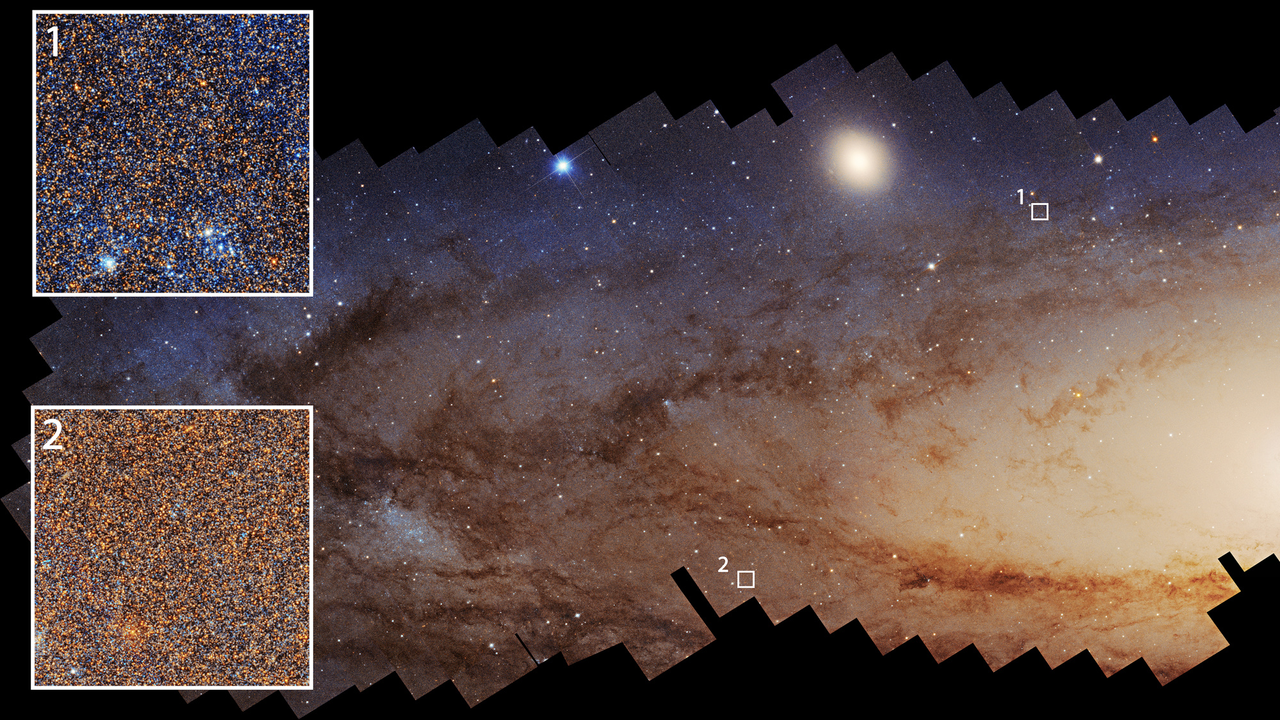
Andromeda galaxy, also known as M31, is a colossal spiral galaxy situated an impressive 2.5 million light-years away in the constellation Andromeda. As the closest large spiral galaxy to Earth, it serves as a valuable laboratory for astronomers studying galaxy formation and evolution. The latest revelation about this celestial neighbor comes from a new analysis of data collected by the Hubble Space Telescope, published in The Astrophysical Journal on July 27, 2026.
The study reveals that Andromeda has been gradually reducing its rate of star formation over the past 500 million years. This trend suggests that the galaxy is winding down following a major burst of activity that occurred around 2 billion years ago. This initial burst of star formation is believed to have created approximately a fifth of all stars currently residing in Andromeda. This development was most likely triggered by a merger with a compact elliptical galaxy called M32, which now orbits the Andromeda galaxy.
According to the research, the rate of star formation in Andromeda fell from one solar mass per year 500 million years ago to just one-fifth of a solar mass each year today. The most recent star formation activity seems to be confined to a ring approximately 32,000 light-years away from the galaxy's core. This gradual decline in star formation activity rather than a sudden halt or depletion of materials indicates that Andromeda's evolution is not an abrupt process.
The researchers also delved into the possible influence of M32 on Andromeda's star formation slowdown. Areas closest to M32 have shown a more recent drop in star formation, which could imply that the companion galaxy might have contributed to the decrease. However, the evidence for this connection remains inconclusive at present.
Lead study co-author Ben Williams, an astronomer at the University of Washington, emphasized the importance of examining individual stars as they serve as the "fossil record" of the galaxy's formation process. Hubble is uniquely positioned to provide high-resolution spatial mapping over a vast area, essential for capturing this vital information.
While further study of Hubble's archive is underway, the team also plans to utilize data from NASA's upcoming Nancy Grace Roman Space Telescope. Scheduled for launch on August 30, the Roman Space Telescope will be able to survey the entire Andromeda galaxy and its surrounding halo with unparalleled detail.
Written by urgent.news from Live Science's reporting — not their text. Machine-written — may contain errors; check the original before relying on it.