Commentary: Forests vs flats? Singapore’s land development debate needs to move beyond that
Amid concerns about clearing Maju Forest for housing, suggestions that Singapore should only build on “brownfield sites” are reasonable. But they may also overlook a few things, says Lee Kuan Yew School of Public Policy’s Woo Jun Jie.
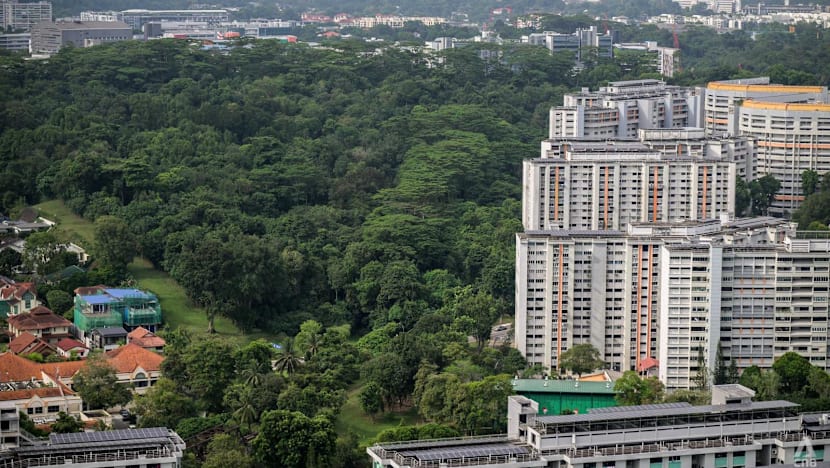
In Singapore, the debate surrounding forest preservation versus housing development has resurfaced following the Housing and Development Board's (HDB) decision to clear a significant portion of Maju Forest for a new residential project. While suggestions that Singapore should solely focus on constructing on "brownfield sites" – previously developed land with existing buildings and infrastructure – are valid, they may also fail to consider certain crucial factors, according to Lee Kuan Yew School of Public Policy's Woo Jun Jie.
The public's response to such housing development plans is typically not a demand for Singapore to cease construction altogether, but rather an expectation that the city-state should first build homes elsewhere. This sentiment has been echoed in previous instances, such as the controversy surrounding the zoning of Dover Forest for residential use in 2021.
Some argue that utilizing underutilized green spaces, such as empty fields, for housing development could be a viable solution. However, the suitability of these sites is contingent on several factors. Existing amenities like supermarkets, preschools, and clinics, as well as transport infrastructure, must be considered. The size of such vacant spaces also plays a role in determining their viability for housing.
While it would be ideal to retain all forests and heritage spaces, Singapore's continued growth necessitates finding new areas to accommodate the increasing demand for housing. Even with a "brownfield first" approach, some green spaces might still need to be repurposed. The key is to do so in a manner that respects our ecological spaces and biodiversity.
For example, Maju Forest will be cleared for new flats in Sunset Way, with 8ha preserved as a wildlife refuge. The HDB has stated that these plans are "not final" as they seek to strike a balance between housing needs and residents' concerns. Similarly, a new housing site at Sembawang will set aside 6ha of existing forest, grassland, and scrubland to safeguard part of an existing freshwater swamp forest.
The Bidadari estate also demonstrates sensitivity towards natural features, integrating knolls, hills, and heritage trees into the housing estate and its park, which earned a gold award in the Master Plan category of the 2024 FIABCI World Prix d'Excellence Awards.
Other cities, such as Sweden and Finland, have successfully integrated substantial amounts of pre-existing woodlands and forests into their residential districts. These examples showcase the importance of striking a balance between housing development and ecological preservation.
Written by urgent.news from Channel News Asia's reporting — not their text. Machine-written — may contain errors; check the original before relying on it.