When Following the Rules Leads to Disaster
A supreme-court decision helped cause the Ceuta disaster.
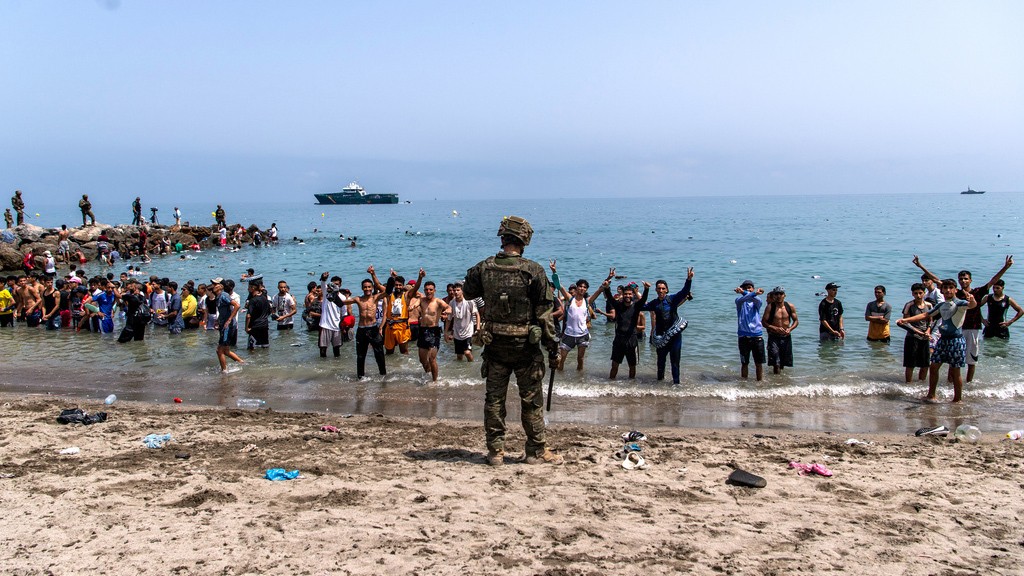
On July 8, Spain's supreme court rendered a decision that proved catastrophic, little suspecting it would result in the deaths of at least 57 individuals, primarily through drowning. The court decreed that individuals who had unlawfully migrated could be repatriated instantly only if they had breached a physical barrier. Should no barrier exist, as in the case of those who crossed open ground or swam, the government would be obligated to undertake a far more intricate deportation process.
Ceuta, a small Spanish territory in North Africa, situated near Morocco and the Mediterranean, emerged as a prime destination for these migrants. This island is equipped with a facility capable of processing about 500 individuals simultaneously. However, on the day of the incident, an estimated 50,000 migrants attempted a perilous swim to Ceuta, particularly in the calm summer months.
This massive influx was apparently orchestrated, aided by social media platforms. A Facebook group, now defunct, provided detailed maps of the treacherous three-hour journey from the Moroccan port of Fnideq, bypassing the land border to ensure a safe landing on sand or rocks, rather than a fence or turnstile.
The migrants exhibited a commendable level of preparation, armed with fins, wet suits, and floaties, and shared a strategic plan of coordination in kayaks to optimize their chances of survival. Among them, a 16-year-old girl was observed, still wet from the sea, her makeup running, and donning jewelry, as if she had just stepped out of a club.
The European Union is likely to grapple with the aftermath of this tragedy for weeks, with Spain facing potential suspension from Schengen, the free movement zone that permits cross-border travel without border checks. Danish and Italian leaders have called for this measure, while Spain has accused human traffickers of exploiting the situation, while Morocco has been criticized for inciting the migrants to provoke Spain.
Socioeconomic factors may have played a role, with Morocco's youth unemployment rate hovering around one-third, coupled with prolonged droughts leading to a decline in farming. However, this explanation requires further investigation, as Morocco's economy has been robust over the past 25 years, propelled by sectors such as automotive manufacturing and phosphate processing.
Despite its unemployment rate being higher than Spain's, the economic disparity may not be as pronounced as one might initially assume, given Spain's own unemployment figure of around 25%, having improved from a peak of 55% in 2013.
The migrants, primarily seeking economic opportunities rather than fleeing persecution, appear to have been well-informed about the rules governing their entry into Ceuta. This knowledge and audacity to flout the system when they perceived it as advantageous has sparked outrage in Spain, with far-right leaders branding the incident an "invasion" and the Prime Minister describing it as an "attack."
The situation underscores the complex interplay between migrants' rational decision-making and the rigid adherence to the law, which has provoked a backlash from Spanish society, irrespective of political leanings.
Written by urgent.news from The Atlantic's reporting — not their text. Machine-written — may contain errors; check the original before relying on it.