Smashed Ice Worlds Formed Neptune's Inner Moons and Rings
The planet Neptune has 16 known moons, with its largest Moon, Triton, comprising more than 99.5 percent of the mass of all of them. Triton’s incredible size has led scientists to hypothesize it was a captured object originating from the Kuiper Belt, which wreaked havoc on Neptune’s original moon system upon its capture and subsequential elliptical orbit. Today, some remnants of these original…
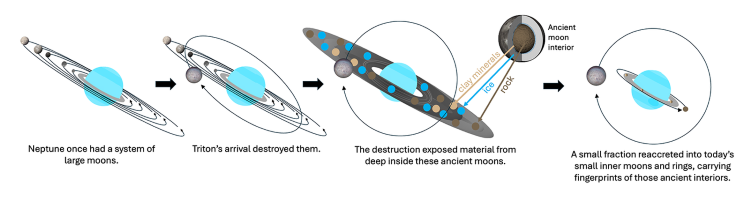
The planet Neptune houses 16 confirmed moons, with the largest, Triton, accounting for more than 99.5% of their combined mass. Scientists have long theorized that Triton was once a captured object from the Kuiper Belt, disrupting Neptune's initial moon system. Today, remnants of this ancient system are seen in the dusty rings surrounding Neptune.
However, the original composition of this moon system remains a mystery. A team of researchers from Caltech may have uncovered key clues. Utilizing NASA's James Webb Space Telescope's Near-Infrared Spectrograph (NIRSpec) instrument, they discovered that Triton and three smaller moons—Proteus, Larissa, and Galatea—along with the rings, lack water ice.
This contrast with other objects in the outer solar system, suggesting a different origin story. Moreover, two of the moons and the rings displayed water-rich clay minerals containing magnesium, signifying a unique origin as well. Dr. Ryleigh Davis, lead author of the study, posited that the moons and rings formed when remnants of larger moons, possibly even a dwarf planet, were shattered when Triton was ensnared by Neptune's gravity.
Proteus, however, did not exhibit the water-rich clay minerals, hinting at its formation from a separate fragment of the debris disk. Researchers believe Neptune's original moon system resembled those found around Uranus, only to be obliterated by the event that led to Triton's capture. This discovery provides a glimpse into the catastrophic processes that shaped Neptune's moons, offering a tantalizing peek into the history of this distant world.
Written by urgent.news from Universe Today's reporting — not their text. Machine-written — may contain errors; check the original before relying on it.