How Michigan Became the Most Expensive Democratic Primary Ever
Next Tuesday’s contest in Michigan between Abdul El-Sayed and Rep. Haley Stevens holds a dubious distinction: No Democratic congressional primary in history has ever attracted so much super PAC cash. The overwhelming majority of the outside money has gone toward ensuring that Stevens, a moderate, pro-Israel Democrat, defeats El-Sayed, a Bernie Sanders-endorsed champion of Medicare […]
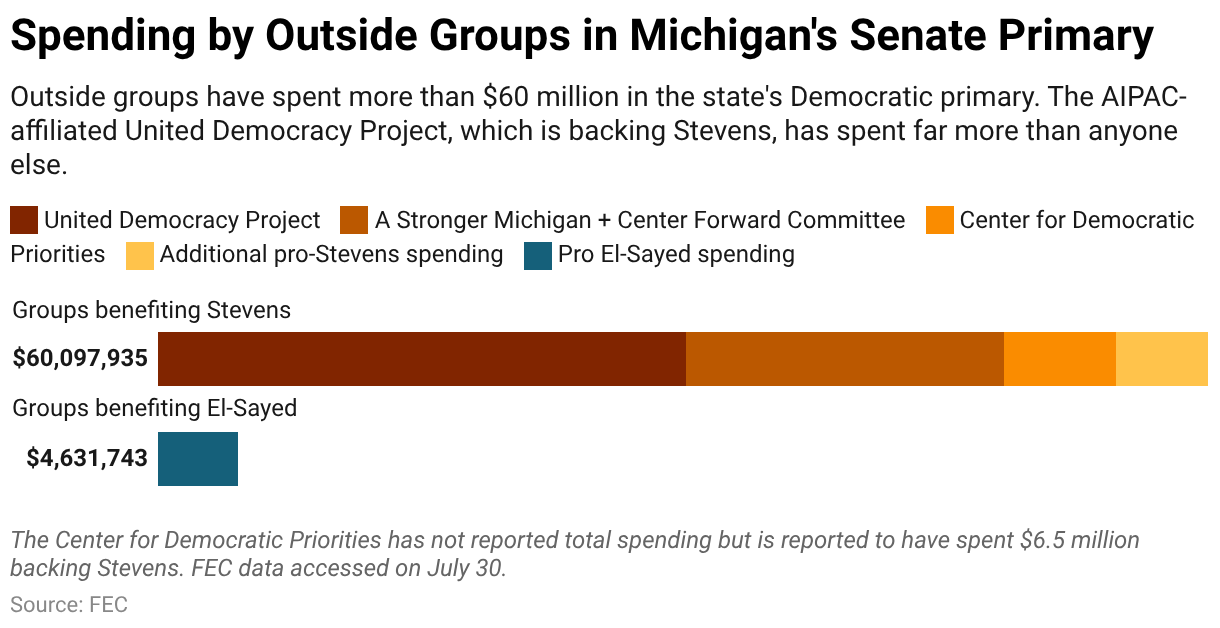
Next Tuesday's Democratic primary in Michigan, featuring Abdul El-Sayed and Rep. Haley Stevens, is set to break records as the most expensive contest ever for a party's congressional race. More than $60 million in super PAC cash has flooded the Senate contest, according to Federal Election Commission and Federal Communications Commission records.
The majority of this money has come from super PACs, which can accept unlimited donations, to ensure Stevens, a moderate pro-Israel Democrat, defeats El-Sayed, a Bernie Sanders-backed advocate for Medicare for All and Israel critic. The United Democracy Project (UDP), a super PAC backed by the American Israel Public Affairs Committee, has spent $30 million backing Stevens, twice as much as any previous single race.
Stevens, who raised over $14.5 million through July, benefited from a super PAC that received donations from companies like Chevron and a Philip Morris subsidiary. The race initially featured three candidates, including state Senator Mallory McMorrow, who dropped out in early July. El-Sayed has endorsements from key left-wing figures like Sanders and Alexandria Ocasio-Cortez, while Stevens is favored by Senate Minority Leader Chuck Schumer and Governor Gretchen Whitmer.
The outcome of the primary will be closely watched to see if populist outsiders can topple establishment favorites, and if left-wing candidates can perform well in swing states. El-Sayed, a 41-year-old Rhodes scholar and doctor, raised more than $14.5 million through July 15, while Stevens raised less than $12 million, with the latter's advantage stemming from super PAC support.
The race has highlighted the issue of outside spending in politics, with Stevens and El-Sayed engaging in debates about their relationships with AIPAC. UDP's unprecedented spending reflects the threat El-Sayed poses to its agenda, despite not explicitly mentioning Israel in its ads, hoping to avoid turning voters off.
Written by urgent.news from Mother Jones's reporting — not their text. Machine-written — may contain errors; check the original before relying on it.