Validation Debt That Your Dashboards Are Not Showing
The gap between how fast AI writes code and how reliably teams verify it is quietly becoming a balance-sheet risk. Enterprise leaders are learning to measure it before it forces repayment. Every engineering organization that adopted AI coding assistants over the past two years has quietly taken on a liability that never appears on the […]
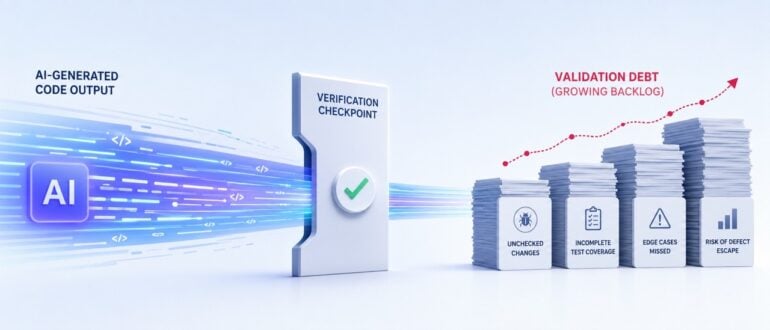
The discrepancy between AI-generated code production speeds and the verification reliability gaps is increasingly emerging as a hidden balance sheet risk for enterprises. Leadership teams are beginning to measure this liability before it prompts repayment. As AI coding assistants have been adopted by engineering organizations over the last two years, an unnoticed liability has grown silently, unbeknownst to the metrics leadership typically reviews.
Developers are now creating more code than their teams can effectively verify, and this gap between production and validation scales with each subsequent build until an incident forces the team to address it. The financial impact of this discrepancy usually arrives late and all at once, typically manifesting as an outage or a failed audit that ties back to a change that was not fully vetted.
For executives responsible for delivery risk, the issue isn't the tool itself, but the fact that verification capacity has not kept pace with the accelerated output. The risk that remains unaddressed due to its absence in dashboards is what constitutes validation debt, as a risk that goes unseen remains unaddressed. Mudit Singh, Co-Founder and Head of Growth at TestMU AI (formerly LambdaTest), has observed this pattern among various enterprise engineering teams he interacts with during company events.
He notes that output surges immediately after a team adopts AI assistance, while verification remains stagnant, and leadership often fails to notice the widening gap until something inevitably breaks, as nothing in their standard reporting makes this debt visible. Singh's broader argument is organizational rather than technical, emphasizing the need to assign validation coverage as a specific responsibility rather than spreading it thinly across a busy team.
He recommends tracking test escape rate as a direct reporting number and treating AI-generated changes as a distinct category, so when leaders assign ownership of this responsibility, the conversation shifts from whether the debt exists to how quickly the organization intends to reduce it. In regulated sectors, the cost of unverified changes is not simply rectified with a quick hotfix but involves an audit finding that may surface months after the code has been deployed.
A passing test suite provides little assurance when the critical question is whether an audit can later prove that the team indeed verified the behavior that mattered. Karthik Karunanithi, a Solution Architect at IBM and a Senior Member of IEEE with two granted United States patents in secure health data, operates in such environments where a passing build is insufficient proof of anything more than the pipeline running.
Karunanithi has implemented a practice where every AI-assisted change must leave behind evidence that another engineer could examine and reproduce the results later. His approach focuses on evidence rather than appearance, ensuring that a green build signifies genuine proof rather than just a successful pipeline run. As teams adopt this approach, they stop questioning whether the build passed and instead inquire what the passing build genuinely proves, transforming their treatment of code that was not written by hand.
Human review cannot scale effectively to keep up with the exponential growth in pull request volume. No matter how much effort reviewers put in, they can only read and understand a limited amount of code per day, a capacity that does not increase simply because AI-generated code is being produced at a faster rate. Abhilash Rao Mesala, a Senior Data Engineer at Meta with fourteen years of experience across healthcare and enterprise systems, witnessed this bottleneck firsthand.
As the volume of AI-assisted pull requests increased on his teams, human review could no longer keep up, leading reviewers to approve changes with shallower scrutiny even though they were aware the depth of review had diminished while the builds continued to appear green. Mesala's solution was to route low-risk changes to an automated reviewer within a defined threshold and reserve human judgment for more consequential changes.
He measures post-merge defects by approval type, providing leadership with a clear indication of whether the balance between speed and safety is being maintained. This approach also discourages sprawling changes that typically conceal the most significant risks. The introduction of agentic systems, which operate without direct human intervention, exacerbates the interest rate of validation debt.
Ahmed Zaidi, CEO and Managing Partner at Accelirate, observes that as enterprises transition from AI-assisted code to fully agentic systems, validation debt compounds more rapidly because the behavior of these systems is no longer deterministic. A single passing test provides even less assurance when the system can exhibit varied behavior, making the need for robust validation mechanisms more urgent.
Written by urgent.news from DevOps.com's reporting — not their text. Machine-written — may contain errors; check the original before relying on it.