Physicists Solve a Big Quantum Mystery. Now, Old Results Don’t Add Up.
New calculations seem to have put a 25-year-old particle physics puzzle to rest. But they’ve also created a clash with other experimental results. The post Physicists Solve a Big Quantum Mystery. Now, Old Results Don’t Add Up. first appeared on Quanta Magazine
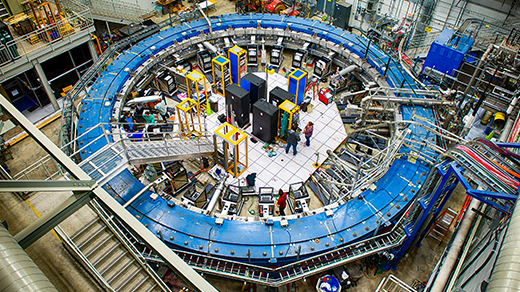
For 25 years, physicists have puzzled over a seemingly minute discrepancy in their understanding of muons, a heavier variant of electrons. This discrepancy arose from conflicting expectations and experimental results. In 2021, however, it appeared that the discrepancy had disappeared. Researchers found that their theoretical predictions aligned much more precisely with experimental observations, to an extraordinary level of accuracy - one part in 100 billion.
This new precision, however, has introduced a new puzzle. The older, less precise calculations still seemed valid, leaving scientists to question why they did not match the more accurate newer results.
These older predictions were not solely based on theory; they were also derived from other experiments. If the older calculations conflicted with the newer results, and the older calculations were grounded in experimental data, could there be something peculiar about those older experiments? One potential clue may lie with a particle collider in Siberia.
This collider recently showed dramatic divergence from its past results and those of other colliders. This divergence has prompted a surge of activity among physicists, who are attempting to determine whether the conflicting measurements are merely a result of different experimental procedures or a sign of new particles emerging.
The muon, a particle with properties akin to a miniature bar magnet, is at the heart of this mystery. When placed in a magnetic field, its magnetic field causes it to wobble, tracing out smaller circles. The extent of this wobble, known as the muon's "g-factor," is determined by a value called the "g-factor." If the muon were isolated from other particles, its g-factor would be exactly 2.
However, due to quantum theory, all other particles influence the g-factor. As the muon wobbles, it emits short-lived particles, such as photons, which can further emit other particles, ultimately causing the muon to reabsorb these fleeting particles. Only their residual effects are observed, manifesting as the muon wobbling slightly more than expected.
Through these complex series of emissions and reabsorptions, all existing particles have some small influence on the muon's movement. This makes the precise size of the excess wobble, or the muon's "g–2," a crucial window into the quantum world. The measurement of the muon's g–2 is like a proxy for understanding how many particles exist in the universe.
When Brookhaven National Laboratory in 2001 measured the muon's g-factor, physicists were thrilled because it came out larger than expected, suggesting the existence of new particles that could possibly account for dark matter. In an effort to verify this result, physicists performed an even more precise measurement in 2013 at Fermi National Accelerator Laboratory (Fermilab) in Illinois.
To prepare for this new experiment, physicists spent considerable time refining their theoretical predictions, particularly the muon's chains of emissions and reabsorptions, especially those influenced by the strong force, which binds quarks into composite particles like protons and neutrons. The strong force, being the most complex to deal with, required innovative theoretical approaches.
One such approach, developed by Alex Keshavarzi in his doctoral thesis in 2018, is the data-driven method. This method avoids predicting how frequently muons will emit and absorb groups of quarks and instead measures it. The primary way to do this is through electron-positron collisions, where matter and antimatter annihilate each other, creating other particles including bundles of quarks.
The more quarks that appear, the stronger they will influence the muon. Using this method, physicists were able to calculate the expected size of the muon's magnetic wobble, which was released in June 2020. This prediction differed significantly from the experimental measurement at Fermilab, released in April 2021. The discrepancy was so significant it came close to crossing the threshold required for physicists to claim a discovery of new particles.
However, different theoretical calculations provided different stories. Not all physicists used the data-driven method for their calculations; some were working on a more purely theoretical technique for their muon wobble prediction, much like how weather forecasters use a 3D grid to calculate average changes in atmospheric conditions instead of tracking every breeze individually.
Written by urgent.news from Quanta Magazine's reporting — not their text. Machine-written — may contain errors; check the original before relying on it.