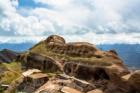
Odd shapes hidden in dense Amazon rainforest reveal sprawling ancient civilization
Newly found earthworks suggest about 3 million people might have lived in just about 3% of the forest’s entire area
Recent aerial surveys using lidar technology have revealed a vast ancient civilization once thriving in the southwestern Amazon rainforest, much larger than previously estimated. Known as the Aquiry, this civilization likely reached its peak between 100 and 300 C.E., with an estimated population of 1.25 million to 3 million people inhabiting over 70,600 square miles of what is now northern Brazil. This area is the size of North Dakota.
Using lidar, researchers discovered nearly 400 previously undocumented geometric earthworks, or "geoglyphs," in a 1,740-square-mile area. These structures were used by the Aquiry for public, ceremonial, and political gatherings, and some spanned up to 123 acres. The precision and scale of these constructions are astonishing, especially considering they were built without metal tools or animals.
Most Aquiry villages consisted of multi-family longhouses, housing around 300 inhabitants each. The civilization flourished from around 600 B.C.E. to 850-950 C.E., with evidence suggesting a rapid collapse during this period, possibly related to the decline of other precolonial civilizations. This discovery challenges the notion of the Amazon as a pristine wilderness, showing that the landscape was shaped by human activity for centuries.
The researchers suggest that similar population densities may have existed in other regions of Amazonia, indicating that the Amazon could have once been home to tens of millions of people before European colonization.
Written by urgent.news from Smithsonian's reporting — not their text. Machine-written — may contain errors; check the original before relying on it.
This story
This is one outlet's version. Read the fullest account.