A new way to trap and twist light inside quasicrystals
By reshaping quasicrystals with carefully designed defects, researchers can create and control stable twisting beams of light in new ways. The post A new way to trap and twist light inside quasicrystals appeared first on Physics World .
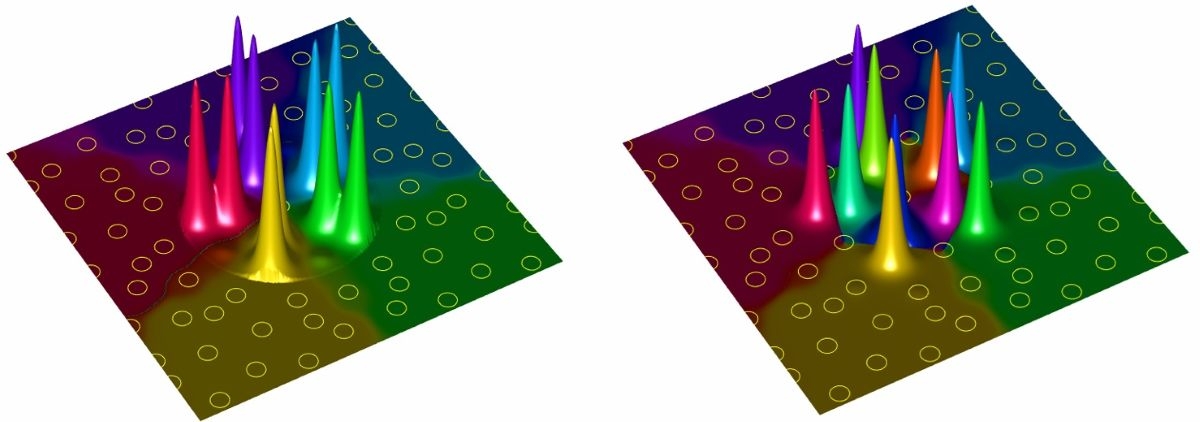
Quasicrystals, a unique class of materials featuring both order and irregular patterns, have long been known to exhibit unusual light behavior. A recent study delved into how vortex beams—twisted light waves—interact with specially modified quasicrystals. By altering the structure, resembling the Penrose tiling and introducing large-scale defects, researchers were able to fine-tune the rotational symmetry of these materials.
Utilizing a standard model for light propagation, they discovered that these modified quasicrystals can support new types of vortex solitons—stable, non-spreading twisted light beams. Typically, such light states require precise energy input and are easily disturbed. However, these quasicrystal-enhanced solitons remain stable even under minimal disturbances and form with weak input power, making them more practical for real-world applications.
Importantly, these vortex beams can encode information in their twisting, offering an additional dimension for data transmission beyond conventional intensity or color. If they maintain stability while traveling, they could significantly boost data-carrying capacity in optical communication systems, addressing the demands for fast and efficient information transfer.
Written by urgent.news from Physics World's reporting — not their text. Machine-written — may contain errors; check the original before relying on it.