Ending clock changes. But which direction should we reset the clock?
The science says Congress is getting it wrong
The Sunshine Protection Act, which would make daylight saving time (DST) permanent, passed the House of Representatives, moving it to the Senate for further consideration. If both chambers approve the bill, daylight saving time would become permanent, resulting in darker mornings throughout the year. However, if the Senate fails to pass the bill, another measure could be introduced to implement permanent standard time instead.
Ending the twice-a-year clock changes is a popular idea, and scientific evidence strongly suggests that stabilizing clock time is beneficial for our health. Despite the Sunshine Protection Act's approval, numerous sleep-medicine and circadian-biology organizations recommend permanent standard time over permanent daylight saving time, which the House recently supported.
Our bodies operate on light, not conventional clocks. The suprachiasmatic nucleus (SCN), a cluster of cells in the brain, controls our circadian rhythm using light as its primary cue. Morning sunlight is the most potent signal for regulating alertness and is far more powerful than indoor light. Darkness at night plays a crucial role, as melatonin—hormone signaling the start of the night—is released only in dim environments.
Exposure to bright light at night suppresses melatonin, potentially delaying sleep and causing later wake times the following day.
The direction in which we change the clocks may have health implications. Losing even a small amount of morning light, such as the average 40 minutes lost during daylight saving time transitions, can have measurable impacts on health. Research indicates that springing forward results in more fatal car crashes, workplace injuries, and sleep-related risks. In contrast, falling back appears to have a less detrimental effect on health and safety.
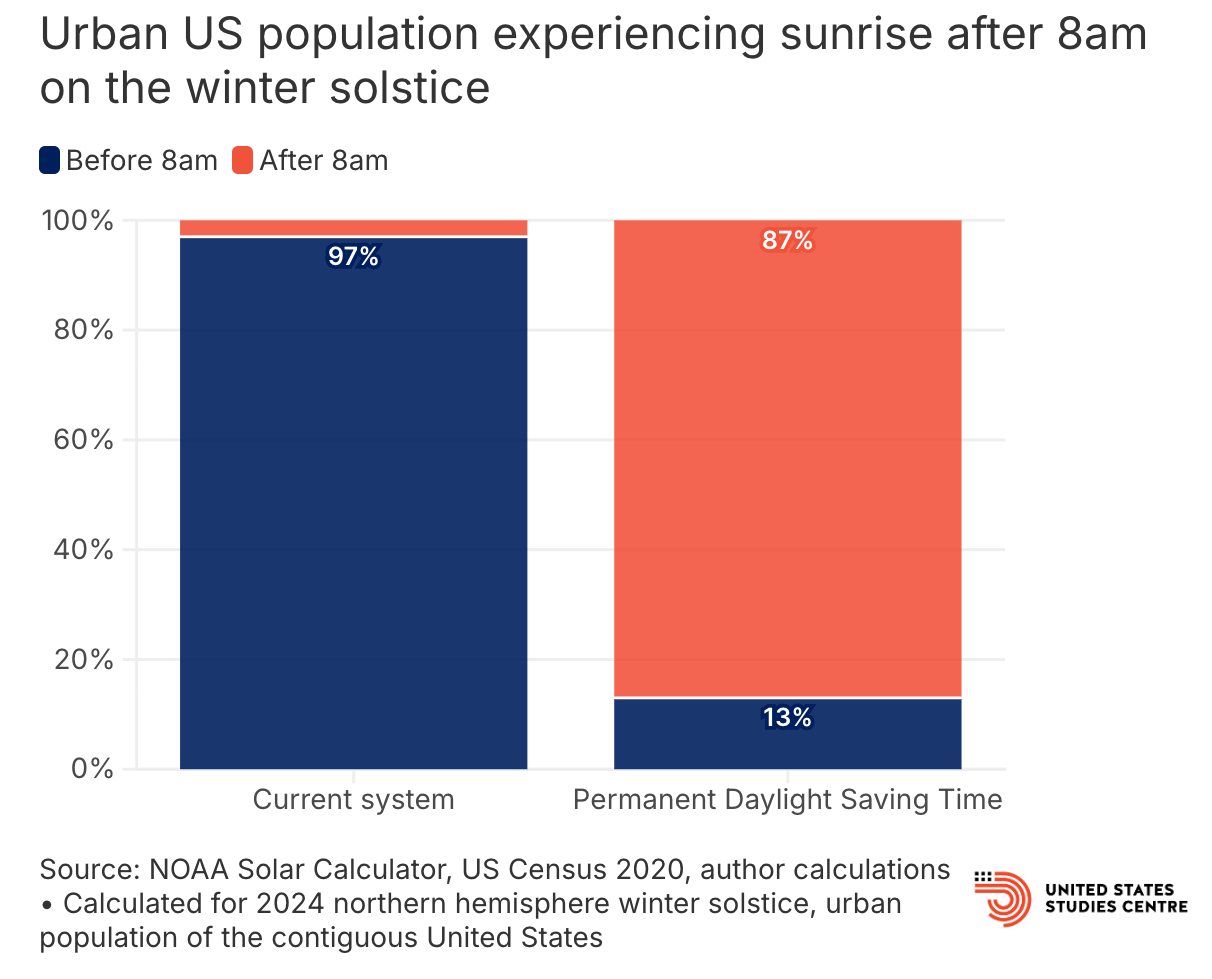
Permanent daylight saving time would expose over 200 million Americans to morning light an hour later, with winter sunrises occurring after 8:15 a.m. in major cities like New York, Chicago, Philadelphia, Washington, D.C., Denver, San Francisco, and Tampa. Studies suggest that permanent standard time aligns more closely with human biology, as it minimizes circadian misalignment and its associated health risks.
Written by urgent.news from Your Local Epidemiologist's reporting — not their text. Machine-written — may contain errors; check the original before relying on it.