Plato's electronics ready for space
Image: The European Space Agency’s terrestrial planet hunter Plato has recently completed a series of key tests inside the Maxwell Test Chamber at ESTEC , demonstrating that its electronic equipment is fit to work in space. This photo captures the spacecraft standing inside the special chamber. The shielded enclosure features conducting metal walls, floor, and ceiling that form a Faraday cage,…
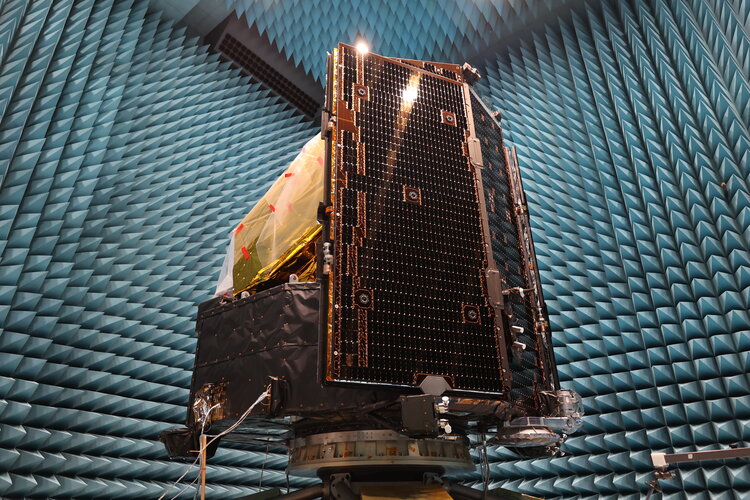
The European Space Agency's spacecraft, Plato, has successfully completed crucial tests inside the Maxwell Test Chamber at ESTEC, ensuring its electronic equipment is prepared for the rigors of space. The shielded enclosure, lined with conducting metal walls, floor, and ceiling, forms a Faraday cage to block external interference.
Within this chamber, Plato's complex instruments and modules were subjected to a series of tests to confirm they wouldn't disrupt each other or communication systems, a process known as crosstalk prevention. This chamber mimics the extreme vacuum of space, where electronics can behave unpredictably compared to Earth-based labs. By passing these tests, engineers confirmed Plato's electronic systems are electromagnetically compatible, meaning they can work together seamlessly in the harsh conditions of space.
Following successful vibration and acoustic tests, and a demanding month-long stay in the Large Space Simulator, Plato is now cleared for launch, set to embark on its journey aboard an Ariane 6 rocket in March 2027.
Written by urgent.news from ESA Space Science's reporting — not their text. Machine-written — may contain errors; check the original before relying on it.